
Gifting & Occasions· 7 min read
Backcountry Hospitality: Gathering and Toasting After a Long Trek
Discover the spirit of backcountry gatherings. This piece explores how rustic rituals and earth-born tools deepen our connection to the wild after a long trek.
By Antler Tree · 1 June 2026
There's a unique quiet that settles over a backcountry hut as the last of the day's light fades. It is a quiet born of shared fatigue and deep satisfaction, an unspoken understanding that the hardest part is over. Now, the rituals of rest and reconnection can begin.
The Unspoken Language of Arrival
The hours leading up to this moment are a blur of exertion. The rhythmic crunch of boots on gravel, the strain of a climb, the focused negotiation of a river crossing—it all melts away at the first sight of the hut's corrugated iron roof. Arrival is a process, a gradual shedding of the trail's demands.
Heavy packs are dropped with a collective sigh, their weight a ghost on tired shoulders. Damp boots are unlaced and lined up by the door, a silent testament to the miles covered. The first tasks are communal and instinctual: splitting kindling for the wood burner, fetching water from the creek, claiming a bunk with a sleeping bag. These are not chores but acts of nesting, of transforming a simple shelter into a temporary home.
As the fire catches and a gentle warmth begins to push back the encroaching chill, a new energy fills the space. The day's solitude gives way to quiet conversation. It is in this transition—from the individual effort of the trek to the communal comfort of the hut—that the spirit of backcountry hospitality truly awakens. It is not about formal welcomes, but about the shared, unspoken agreement to create a place of comfort and camaraderie together.
More Than a Drink: The Story in the Serving
When the packs are finally unbuckled for the second time, it is not for gear, but for provisions. Out come blocks of cheese, dense crackers, and the prized, carefully carried bottles of beer or a small flask of whisky. The sharing of these modest luxuries is a cornerstone of hut culture. The clink of a bottle on the rough-hewn wooden table is an audible punctuation mark, signaling the end of the day's labour and the beginning of the evening's storytelling.
This act of serving a drink is a ritual. It is an invitation to recount the day's highs and lows: the kea that shadowed your lunch spot, the unexpected beauty of a hidden waterfall, the navigational error that became an adventure. The drink itself is secondary to the moment it creates. It is a catalyst for connection, a reason to gather closely around the small table as steam fogs the single-paned windows.
In this environment, every object takes on a greater significance. There are no drawers full of utensils, no mismatched sets of glasses. There is only what has been carried in. The tools we use to perform these simple rituals—slicing the cheese, pouring the drink, opening the bottle—become integral parts of the experience.
The Tangible Connection to the Wild
The power of a physical object to ground us in a moment is often underestimated. In the backcountry, this effect is magnified. After a day spent immersed in the raw beauty of the New Zealand wilderness, the tools we interact with in the evening can either extend that connection or sever it. They can feel like an extension of the landscape itself, or like an intrusion from a world far away.
Consider the simple act of opening a bottle. A mass-produced opener with a plastic handle does the job, but it tells no story. Its uniform shape and synthetic feel are products of a factory, entirely disconnected from the tussock-covered ridges and ancient beech forests outside the hut door. It is functionally present, but spiritually absent.
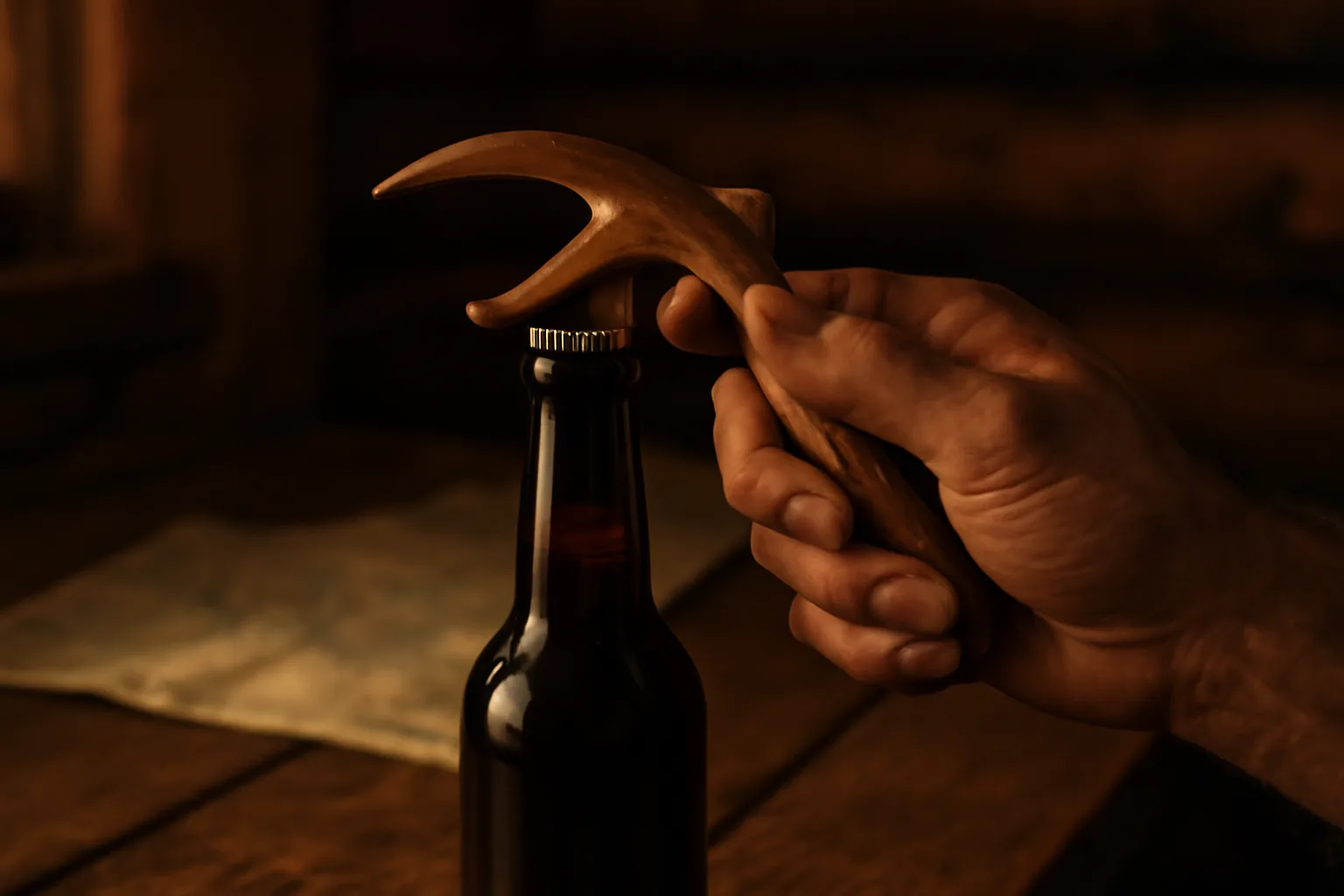
Now, imagine using an opener crafted from a piece of naturally shed New Zealand red deer antler. The immediate difference is haptic. The tool has a satisfying, organic weight and a unique texture shaped by its life in the wild. Its surface is not perfectly smooth; it might bear the faint grooves where velvet once grew or the subtle abrasions from rubbing against rock and bark. Holding it is a tactile experience that connects you directly to the natural world. Instead of grasping sterile plastic, your hand is closing around a piece of the very environment you just spent hours traversing.
This physical connection triggers a deeper, psychological one. An antler is a biological artifact, a direct product of the animal and its habitat. A stag grows and sheds its antlers over a yearly cycle that is intrinsically tied to the seasons, the available forage, and the ruggedness of the terrain. A piece of shed antler found on a forest floor in Fiordland is, in a very real sense, a distillation of that specific place. Using an object made from it is not just a mechanical action; it is an interaction with a story. It reinforces the sense of place, reminding you that your temporary home in this hut is part of a much larger, living ecosystem. The tool in your hand is a piece of that wildness, brought respectfully to the table.
Craftsmanship That Endures the Elements
Objects intended for the backcountry must be more than just beautiful; they must be resilient. The materials we choose for our gear are selected for their ability to withstand hard use, and the tools for our hospitality rituals should be no different. Antler is a material born of this principle. It is bone, designed by nature for combat and display, and is consequently incredibly dense and durable.
When a craftsman takes this raw material, the goal is not to erase its wild character but to refine it into a functional form. It involves carefully seeing the potential in a particular curve or fork, making precise cuts, and fitting it with high-quality components that will not fail. A well-made tool, like a handcrafted antler bottle opener, is designed not just for a single trip, but to become a trusted part of your gear for years to come. It acquires the patina of memory with each use—a faint scratch from a fireside story, a smoothness from countless hands. It becomes an heirloom of your adventures.
The Character of Shed Antler
There is a profound difference between antler taken by a hunter and antler that has been naturally shed. The annual shedding is a peaceful, natural part of a stag’s life cycle. Finding a piece of shed antler on the forest floor is a quiet discovery, a gift from the landscape. These pieces often carry a unique character, weathered by sun and rain, perhaps gnawed by smaller forest creatures, telling a tale of their time spent resting amongst the ferns and moss.
This origin story is vital. It means the object you hold was sourced without harm, in full respect of the animal and its wild domain. It embodies a sustainable, patient ethos that aligns perfectly with the mindset of those who seek solace and adventure in the high country.
A Tradition of Backcountry Hospitality
Gathering in a hut at the end of a long tramp is a tradition that connects generations of New Zealanders. These simple structures are repositories of stories, with logbooks filled with the names and notes of those who have sheltered there before. In this space, hospitality is not about elaborate gestures, but about genuine, unpretentious sharing.
It is about offering a cup of tea to a hiker who arrives late and cold. It is about contributing your scant supply of chocolate to a communal dessert. And it is about the small, satisfying rituals that turn a meal into a celebration. The tools we use become part of this tradition. A beautiful, durable object like an antler opener becomes more than a personal possession; it becomes part of the shared experience, a talking point, and an artifact of the gathering. It is a small but meaningful way to honour the wildness of the landscape and the warmth of the company you share it with.
In the end, the most memorable moments are often the simplest ones, elevated by a deeper connection to our surroundings. The tools we choose to bring into these sacred spaces matter. They can be forgettable implements, or they can be story-laden objects that enrich the ritual and deepen our appreciation for the wild places we are privileged to explore.
Related reading

Gifting & Occasions· 6 min read
Protecting Garment Linings: The Hardness Scale of Your Key Ring
Why do keys ruin pocket linings? We explore the material science of hardness and friction, and explain how smooth, rounded deer antler offers a fabric-safe, elegant solution.
Read article →

Gifting & Occasions· 6 min read
Stabilizing Dry Seals: Extracting Recessed and Stubborn Wine Corks
Learn the expert technique for extracting dry, recessed, and stubborn wine corks without ruining the wine. Discover how grip and tool design are key to success.
Read article →

Gifting & Occasions· 6 min read
Executive Gift Trends: Why High-Level Partners Prefer Tactile Office Art
Corporate gifting is shifting from plastic tech to tactile office art. We explore why modern executives value functional, analog items that serve as premium desk conversation pieces.
Read article →