Gifting & Occasions· 6 min read
Protecting Garment Linings: The Hardness Scale of Your Key Ring
Why do keys ruin pocket linings? We explore the material science of hardness and friction, and explain how smooth, rounded deer antler offers a fabric-safe, elegant solution.
By Antler Tree · 1 June 2026
It is a quiet, slow-motion tragedy that plays out in pockets around the world. The integrity of a favourite garment—a tailored suit trouser, a well-worn pair of jeans—is gradually compromised not by a dramatic accident, but by the daily, repetitive stress of the keys we carry. This isn't a failure of the garment; it's a fundamental mismatch between the tools we use and the textiles they live alongside.
The Slow Betrayal of a Pocket Lining
It begins subtly. You reach for your keys and a finger catches on a loose thread inside your pocket. A few weeks later, you might discover a small, perplexing hole, as if a moth decided to target a single, inaccessible spot. Over months, this small tear widens into a genuine breach. Soon, your keys, loose change, and other pocket ephemera begin to migrate into the hidden world of your trouser leg or jacket lining. That once-reliable pocket is now a liability.
The culprit is an object we handle dozens of times a day, yet rarely consider from a material perspective: the modern key. Bundled together, a set of keys becomes a jagged, abrasive cluster of machined metal. Each time you walk, sit, or simply move, this metallic burr grinds against the soft, woven threads of your pocket lining.
Fine wool suiting, with its delicate weave, is often the first to surrender. The high-twist yarns that give the fabric its drape and lustre are no match for the serrated edge of a house key. Cotton linings in chinos and jackets offer more resistance, but they too will eventually fray and give way under the constant frictional assault. Even rugged denim, known for its durability, will show signs of abrasion, a pale, worn patch telegraphing the eventual failure of the pocket bag beneath.
We blame the tailor or the brand, but the problem lies in the object itself. We have optimised keys for their interaction with a lock, prioritising the hardness and sharp precision needed to operate a pin-tumbler mechanism. In doing so, we have inadvertently designed the perfect tool for destroying fabric.
A Material Problem: Hardness, Shape, and Friction
To understand why a simple key is so destructive, we need to look at it through the lens of material science. The core of the issue comes down to three factors: hardness, shape, and friction. Most keys are cut from brass or a nickel-silver alloy, with some high-security or modern keys using stainless steel. These metals are chosen for their durability and resistance to wear inside a lock.
On the Mohs scale of mineral hardness, which rates materials from 1 (talc) to 10 (diamond), brass typically registers around a 3-4. Stainless steel is significantly harder, rating between 5.5 and 6.3. Woven fabric, by contrast, is a composite of soft organic fibres with a hardness barely registering on the scale. When a much harder material is repeatedly scraped against a much softer one, the harder material will always win, abrading and cutting the softer one.
However, hardness alone is not the full story. A polished steel ball, despite its hardness, would be relatively harmless in a pocket. The true destructive power of a key comes from its shape. A key is a study in sharp angles and concentrated force. The teeth, or ‘bitting’, are a series of peaks and valleys machined to precise specifications. The tip is often a sharp point, and the bow (the part you hold) can have squared-off edges from the stamping process. Each ofainst your pocket lining, these sharp points act like tiny knives. They concentrate the force of your body’s movement onto a microscopic area, creating immense pressure that can sever a single fabric thread with ease. This process repeats thousands of times a day, and the cumulative effect is the hole in your pocket.
The Antler Alternative: Nature's Pocket-Friendly Material
If the problem is the aggressive nature of machined metal, the solution must lie in a material that is both durable enough for daily use and inherently kinder to its surroundings. This is where we find a remarkable solution in one of nature’s most elegant materials: naturally shed red deer antler.
Antler, sourced from the wild herds of New Zealand, is a composite biological material. It is bone, but it is unlike any other bone in the animal kingdom due to its annual cycle of growth and regeneration. Its primary components are minerals like calcium phosphate, which provide hardness and rigidity, woven into a flexible protein matrix of collagen. This composite structure gives it a unique combination of strength and resilience that metals lack. But its true advantage in this context lies not just in its composition, but in its surface properties once crafted.
The Low-Friction Logic of Antler
The hardness of antler bone is around 5 on the Mohs scale, placing it in a similar category to some steels. This number, however, is deeply misleading. The genius of an antler key fob is how it interacts with fabric, which is governed by pressure and smoothness, not just raw hardness. Whereas a metal key is stamped with sharp edges, the tip of an antler tine is a naturally grown, rounded form.
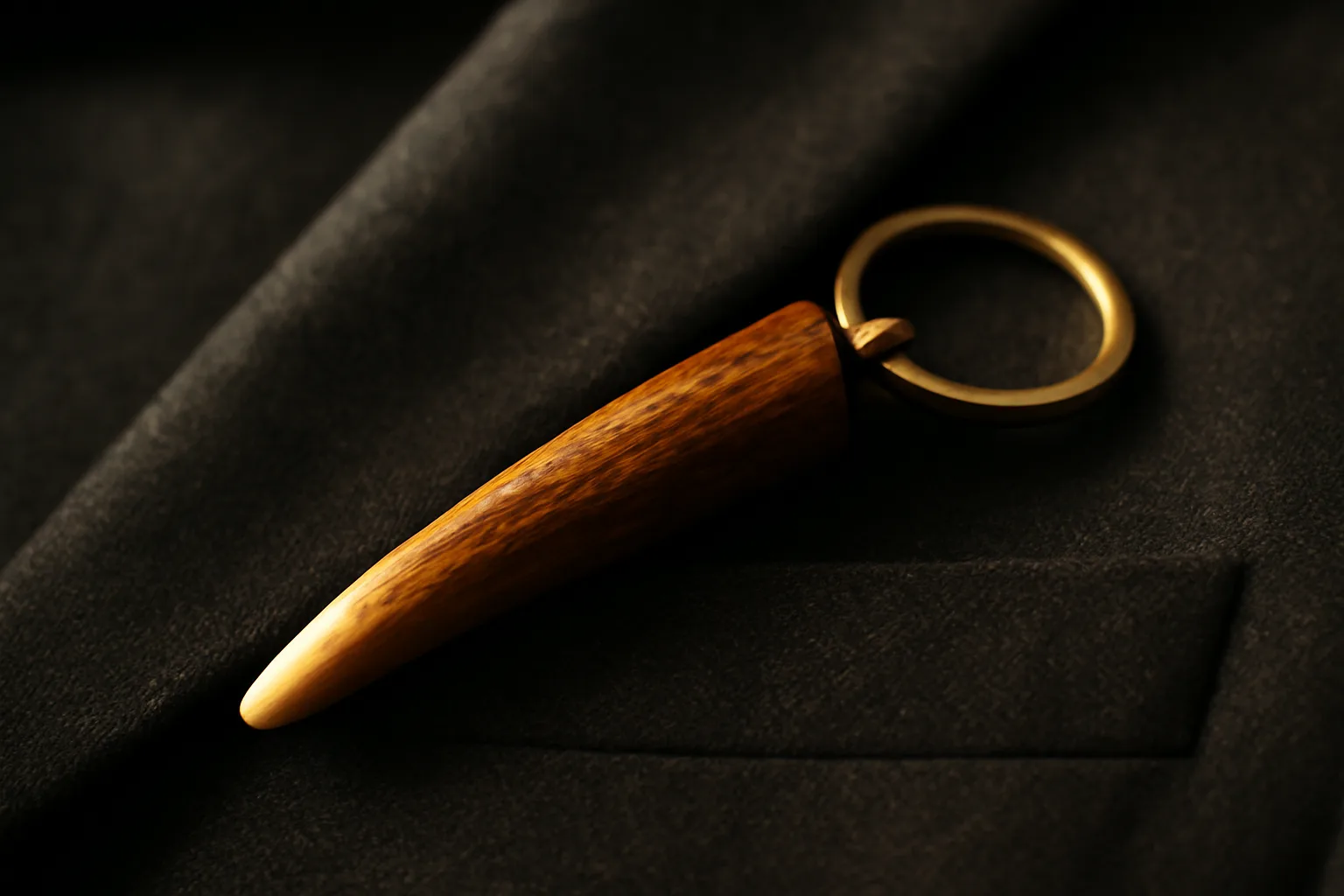
When we handcraft a key ring from an antler tip, we sand it through multiple fine grits and polish it to a glass-like finish. This process removes any microscopic texture and creates an incredibly low-friction surface. The physics are simple yet profound. A sharp metal key tip concentrates force into a tiny area, creating high pressure (Pressure = Force / Area) sufficient to slice threads. The broad, smooth, rounded surface of a polished antler tip distributes the very same force over a much, much larger area. This results in dramatically lower pressure at any single point on the fabric, far below the threshold needed to cut or even damage a thread.
It is the difference between pushing a needle against your skin and pushing your fingertip with the same amount of force. One pierces, the other does not. The antler is the fingertip. Furthermore, the inherent composite nature of antler—hard minerals within a soft protein matrix—gives it a micro-flexibility. It has a compliance that allows it to absorb impacts and glide over surfaces rather than digging into them. It dampens energy, which is why it feels quiet and warm in the hand, and why it sits silently and harmlessly in a pocket.
Beyond Function: The Craft and Character of Antler
Choosing an object made from antler is about more than just solving a practical problem. It is an embrace of an entirely different philosophy of design and ownership, one rooted in nature, craft, and sustainability.
Every piece of antler we use at our New Zealand workshop is naturally shed. Red deer stags grow and cast their antlers each year in a remarkable cycle of renewal. No animals are harmed; we simply walk the hills and forests to collect what nature has left behind. This imbues the material with a story of life and place that mass-produced metal or plastic can never replicate.
The crafting process is a conversation with the material. We select a specific tine for its shape, size, and character. We cut and shape it by hand, then begin the slow, deliberate process of sanding and polishing. This brings out the unique inner texture of the antler—a porous, beautiful matrix that tells the story of the animal's life. The result is a piece that feels both ancient and modern, a tactile object that elevates a daily routine. Each Antler Key Ring carries the unique story of the deer that shed it and the artisan who shaped it into a new, functional form.
This stands in stark contrast to the anonymous, cold, and often noisy jumble of a typical keychain. An antler fob feels warm to the touch, its organic shape conforming naturally to the hand. It has a pleasing weight and substance, yet it is quiet, absorbing the clatter of the keys it secures.
Integrating a Kinder Key Ring
Adopting a more considered approach to your daily carry is a simple but rewarding change. Consolidating your essential keys onto a single, well-designed fob not only reduces pocket-clutter but also introduces a moment of tactile pleasure into your day. The act of handling an object that is natural, handcrafted, and beautiful provides a small antidote to a world of mass production.
As a gift, it is an exceptionally thoughtful gesture. It shows an appreciation for detail, an understanding of quality, and a concern for the small, everyday experiences of the recipient. It is a gift for the person who appreciates fine tailoring, who invests in quality leather goods, or who simply finds joy in well-made objects that are designed to last and age with grace.
Ultimately, a key ring is a small thing. But our lives are made up of an accumulation of small things, of daily routines and habitual interactions. Choosing an object that is not only functional but also beautiful, sustainable, and gentle on its surroundings is a small vote for a more considered way of living. It is a recognition that even the most mundane items we carry can, and should, bring us a measure of quiet satisfaction.
The objects we choose to carry say something about our values. A piece of handcrafted New Zealand antler speaks of a connection to nature, an appreciation for lasting craft, and an eye for the quiet details that make life richer. We invite you to hold one in your hand and feel the difference for yourself.
Related reading
Gifting & Occasions· 6 min read
Stabilizing Dry Seals: Extracting Recessed and Stubborn Wine Corks
Learn the expert technique for extracting dry, recessed, and stubborn wine corks without ruining the wine. Discover how grip and tool design are key to success.
Read article →

Gifting & Occasions· 6 min read
Executive Gift Trends: Why High-Level Partners Prefer Tactile Office Art
Corporate gifting is shifting from plastic tech to tactile office art. We explore why modern executives value functional, analog items that serve as premium desk conversation pieces.
Read article →
Gifting & Occasions· 7 min read
Backcountry Hospitality: Gathering and Toasting After a Long Trek
Discover the spirit of backcountry gatherings. This piece explores how rustic rituals and earth-born tools deepen our connection to the wild after a long trek.
Read article →