
Gifting & Occasions· 6 min read
Stabilizing Dry Seals: Extracting Recessed and Stubborn Wine Corks
Learn the expert technique for extracting dry, recessed, and stubborn wine corks without ruining the wine. Discover how grip and tool design are key to success.
By Antler Tree · 1 June 2026
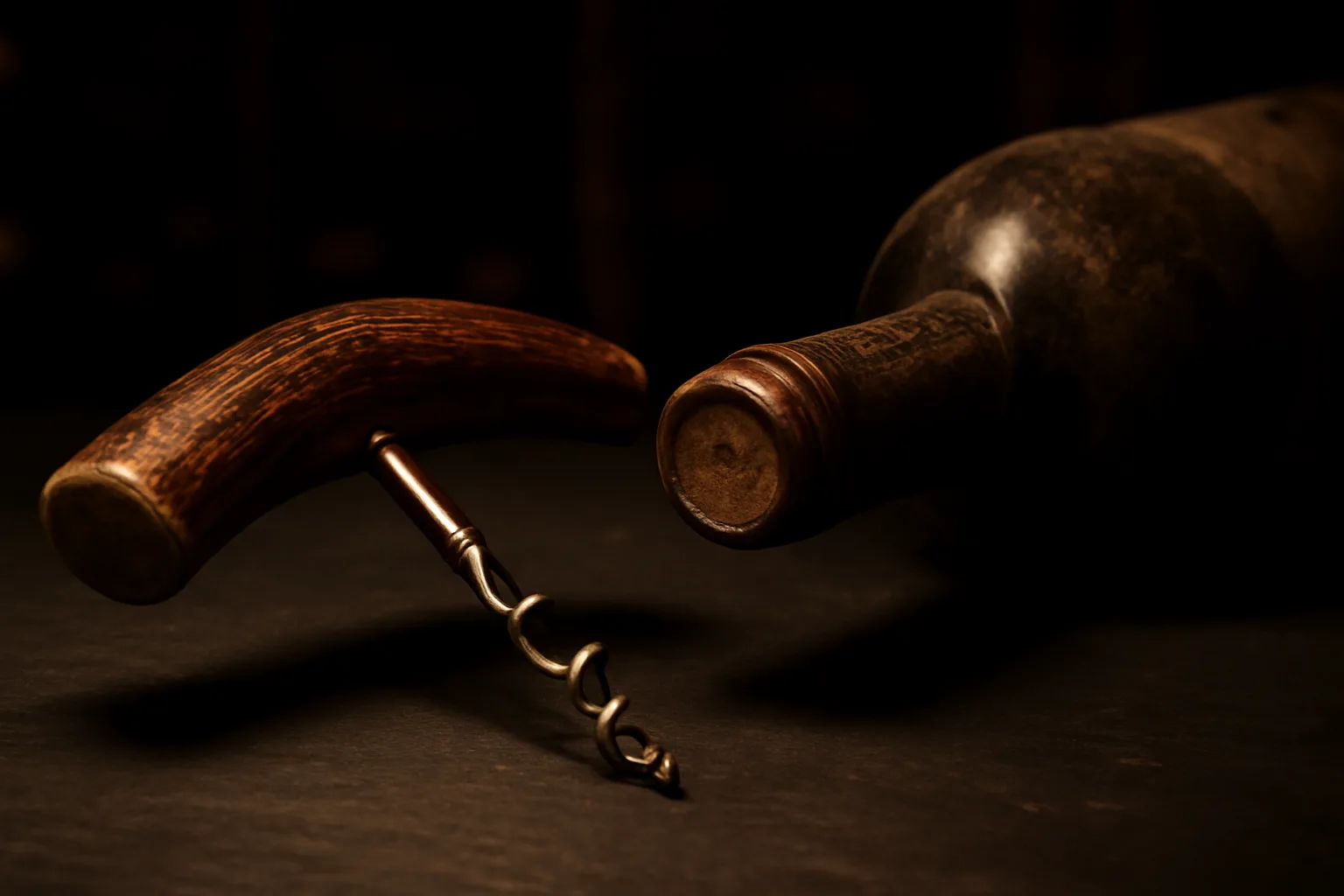
There is a unique moment of quiet panic that arrives when a wine cork, especially from a bottle kept for a special occasion, refuses to cooperate. It is more than a simple inconvenience; it is a test of patience and technique, a challenge to preserve the integrity of a moment years in the making.
The Anatomy of a Failed Cork
Before we can address the solution, we must understand the problem. A cork is a piece of bark, a natural material subject to the laws of physics and biology. Its primary job is to create a hermetic seal against the glass neck of a bottle, protecting the wine from its greatest enemy: oxygen. For this to work, the cork must remain elastic and moist. This is why wine is traditionally stored on its side, ensuring the liquid keeps the cork's inner face saturated.
When a bottle is stored upright for long periods, or in an environment with low humidity, the cork begins to dry out from the top down. It loses its elasticity, shrinks, and becomes brittle. Sometimes it adheres stubbornly to the glass, a bond of friction and age. Other times, the top portion desiccates and crumbles, allowing the main body of the cork to slip down below the rim line, creating a deep, shadowy recess. This is the 'stabilizing seal' of the title—a seal that has become static, dry, and unyielding.
It is crucial to remember that a difficult cork is rarely a reflection on the quality of the wine within. It is a materials science issue, a testament to the passage of time and the environmental conditions the bottle has endured. Our task is not to curse the cork but to outwit it with a steady hand and the correct approach.
The Cardinal Rule: Do No Harm
When faced with a stubborn or recessed cork, the prime directive is to protect the wine. The goal is to open the bottle, not to perform a rescue operation that ends in a tragic slurry of cork dust and shattered expectations. Rushing the process or turning to misguided 'hacks' is the fastest way to contaminate a beautiful vintage.
Pushing the cork into the bottle should be avoided at all costs. This action causes a sudden and dramatic oxygenation of the wine, altering its delicate aromatic compounds. Furthermore, any dust, mould, or debris that was sitting on top of the cork is now washed directly into the liquid you intend to serve. Similarly, attempting to pry out fragments with a knife is a dangerous game that risks a broken tool, a chipped bottle, or a sliced finger, all while showering the wine's surface with cork particles.
Success requires a shift in mindset. We are not applying brute force. We are performing a delicate extraction, using mechanical advantage and a deep understanding of the materials at play.
The Mechanics of a Controlled Extraction
A standard waiter's friend, or sommelier's knife, remains the most capable tool for this task, provided it is of good quality. A cheap, flimsy corkscrew with a thick, dull worm (the spiral part) will only tear and destroy a fragile cork. A quality tool will have a thin, sharp worm with a smooth coating that cuts into the cork rather than pushing it apart.
Preparation and Positioning
First, prepare your workspace. Place the bottle on a solid, non-slip surface. Its stability is your stability. Take a damp cloth and meticulously wipe the bottle's lip and rim. You want to remove any dust or grime that could fall into the bottle upon the cork's eventual exit.
The Gentle Approach
For a recessed cork, the standard central insertion is not ideal. The key is to insert the worm off-centre. Aim the point of the worm directly against the side of the glass neck and then angle it slightly inward as you begin to twist. Turn slowly and gently. Your goal is to drive the worm down the side, embedding it as deeply as possible into the most solid part of the remaining cork. This angled approach maximizes the worm's grip on what little purchase is available.
Once the worm is inserted, engage the first lever of your waiter's friend on the lip of the bottle. Apply slow, steady upward pressure. Watch and feel how the cork responds. If it moves even a millimetre, you are on the right path. Do not try to pull it all the way out on the first go. Use the first lever to lift it partway, then switch to the second, longer lever for the final extraction.
The Physics of the Final Pull: Grip, Tremor, and Torque
The most delicate part of the entire procedure is the final upward pull. This is where most extractions fail. The force exerted must be almost perfectly vertical. Any lateral, or sideways, component of that force will shear the brittle cork against the hard edge of the bottle neck. This is not a matter of strength, but of control, and control begins in the hand.
Every person's hand has a natural, involuntary micro-tremor. When you grip a tool, especially with force or concentration, these tremors can be amplified. A smooth, thin, or poorly designed corkscrew handle offers little in the way of tactile feedback and requires a significant amount of clamping force from your hand just to prevent slipping. This tension increases tremor, which translates directly into unsteady, non-vertical force on the cork. The tool itself is actively working against you.
This is where the principles of ergonomics and material selection become paramount. A handle crafted from a material like naturally shed New Zealand red deer antler offers a profound mechanical advantage. The unique, organic contour of each piece, having grown rather than been machined, provides a superior ergonomic fit. It fills the palm, distributing pressure over a wider surface area instead of creating hotspots. This distribution allows for a more relaxed grip. The surface of antler, with its inherent porosity and subtle texture, possesses a much higher coefficient of friction than polished steel or plastic. It's a non-slip surface, naturally. This means you do not need to squeeze as hard to maintain control, which in turn reduces muscle tension and minimizes hand tremor.
By uniting a comfortable, contoured shape with a high-friction surface, a well-crafted handle guides the user's arm and wrist into a biomechanically stable position. The result is that the force you intend to apply—a clean, straight, upward pull—is precisely what gets delivered. It allows your focus to remain on the cork, not on fighting your own tool. This level of control is what makes a piece like the handcrafted Antler Corkscrew more than just a beautiful object; it is a high-performance instrument for a very specific and delicate task.
When All Else Fails
For those who regularly open aged bottles, there are more specialized tools. The 'Ah-So', sometimes called the butler's thief, is one such device. It consists of two thin, flexible prongs of different lengths. The prongs are inserted between the cork and the neck of the bottle, one after the other. They cradle the cork from the outside, allowing you to extract it whole even if it is completely saturated and fragile. It requires some practice but is an invaluable tool for the serious collector.
At the far end of the spectrum lies the dramatic method of Port tongs. These heavy iron tongs are heated in a fire until glowing red. They are then clamped around the neck of the bottle for about a minute. A wet cloth or feather is then brushed across the heated glass, causing a clean thermal break. The top of the neck, along with the cork, is lifted off cleanly. This method is pure theatre and a last resort, best reserved for very old, very valuable bottles of Port where the cork is expected to be completely unsalvageable.
Opening an old wine should be an act of reverence, not a battle. It is a conversation with the past, and it pays to be a good listener. Understanding the challenge, choosing the right instrument, and applying a patient, considered technique is all that stands between you and the perfect pour. A moment of preparation and the right tool in hand can transform a potential disaster into a small, quiet moment of triumph.
Related reading
Gifting & Occasions· 6 min read
Protecting Garment Linings: The Hardness Scale of Your Key Ring
Why do keys ruin pocket linings? We explore the material science of hardness and friction, and explain how smooth, rounded deer antler offers a fabric-safe, elegant solution.
Read article →

Gifting & Occasions· 6 min read
Executive Gift Trends: Why High-Level Partners Prefer Tactile Office Art
Corporate gifting is shifting from plastic tech to tactile office art. We explore why modern executives value functional, analog items that serve as premium desk conversation pieces.
Read article →
Gifting & Occasions· 7 min read
Backcountry Hospitality: Gathering and Toasting After a Long Trek
Discover the spirit of backcountry gatherings. This piece explores how rustic rituals and earth-born tools deepen our connection to the wild after a long trek.
Read article →