
Gifting & Occasions· 6 min read
Designing a Compact Home Bar: The Three Essential Tools You Actually Need
A minimalist blueprint for setting up a functional home bar. Discover the 'Frequency of Use' framework and the three essential, tactile tools you actually need.
By Antler Tree · 1 June 2026
The modern cult of convenience has led us to believe a worthy home bar requires a battalion of single-use appliances. We disagree. A truly functional and elegant bar is defined not by what it has, but by what it does without, focusing on ritual and quality over clutter and automation.
Rethinking the Home Bar: From Appliance Graveyard to Curated Space
Walk through any department store and you will be sold a vision of home entertainment that is loud, plastic, and ultimately, disposable. The promise is one of effortless hosting, embodied by whirring margarita machines, electric cocktail shakers, and automated wine openers. These gadgets promise to save you time and effort, to transform your humble kitchen counter into a professional-grade speakeasy with the push of a button.
The reality, however, often proves to be an appliance graveyard. That frozen drink maker, used for one summer party, now gathers dust in a high cupboard. The electric corkscrew, which saves a grand total of five seconds per bottle, sits uncharged and forgotten. These items are solutions in search of a problem. They are designed for a single purpose, and when that specific, infrequent need does not arise, they become dead weight—physical and aesthetic clutter that detracts from the calm and character of your home.
True hospitality is not about automation. It is about connection, process, and the quiet confidence of using a well-made tool. The act of making a drink for a guest—the measure, the stir, the pour—is a small ritual. It is a moment of focused craft. By stripping away the unnecessary electronic intermediaries, we rediscover this satisfaction. We trade the impersonal hum of a motor for the satisfying heft of steel, the smooth grain of wood, or the unique texture of antler in our hands. A curated home bar is an extension of this philosophy: an intentional space built around a few versatile, beautiful, and enduring tools.
The "Frequency of Use" Framework: Your Blueprint for Minimalism
To move from a cluttered countertop to a curated bar, you need a filtering mechanism. We call it the “Frequency of Use” framework. It is a simple but powerful mental model for evaluating any potential bar tool, helping you distinguish between an essential and an encumbrance. The framework rests on one core principle: a tool’s place in your space is justified only if its frequency of use is high and its function cannot be elegantly performed by a more versatile alternative you already own.
Let's apply this to common bar-related purchases:
Category 1: The High-Frequency Impostor. Consider the electric wine opener. It performs a single task: removing a cork. A host who enjoys wine might use it once or twice a week, perhaps 100 times per year. The device itself, however, introduces multiple points of failure: a rechargeable battery with a finite lifespan, a motor prone to burning out, and a plastic housing that can crack. It saves, at best, a few seconds per bottle. Compare this to its manual counterpart, the waiter’s corkscrew. It has no battery, no motor. Its mechanism is a simple, robust application of leverage. Its lifespan is measured in decades, not charging cycles. The electric version offers a negligible benefit for a significant trade-off in reliability and longevity. Its perceived value is high, but its functional advantage is practically zero.
Category 2: The Low-Frequency, Low-Value Gadget. This is the territory of the dedicated margarita machine or the automated cocktail station. Ask yourself honestly: how many times in a year will you make a batch of frozen margaritas? Let’s be generous and say four times for summer gatherings. For the other 361 days, this bulky appliance is pure storage cost. Meanwhile, a quality blender—a kitchen workhorse you already own for smoothies, soups, and sauces—can perform the exact same task of crushing ice. The specialized machine offers zero functional gain for over 98% of its life, while occupying 100% of its counter space. Automated cocktail dispensers present an even worse equation. The ‘work’ of making most classic cocktails (shaking or stirring) takes less than 30 seconds. The cleanup of a complex automated system, with its myriad tubes and reservoirs, can take ten minutes. The math does not support the convenience claim.
By applying the Frequency of Use framework, the path to a minimalist bar becomes clear. You are not looking for tools that do one thing with a marginal time savings. You are looking for versatile, reliable tools that perform fundamental, frequent tasks with grace and durability.
Essential Tool #1: The Double-Hinged Waiter's Corkscrew
If you drink wine, there is no better tool for opening it than the double-hinged waiter’s corkscrew, also known as a sommelier knife. Its design is a small miracle of mechanical engineering, and its superiority over other corkscrews is not a matter of opinion, but of physics.
The Power of the Double Hinge
The key is the two-step leverage system. Cheaper single-hinged models or clumsy ‘wing’ corkscrews require you to pull the cork out in one long, often forceful motion. This puts uneven pressure on the cork, increasing the risk of it breaking or crumbling. The double-hinged design provides two distinct pivot points. The first hinge lifts the cork halfway out with minimal effort. You then shift to the second hinge to pull it the rest of the way. This two-stage process keeps the screw perpendicular to the cork throughout the extraction, ensuring a clean, whole pull every time.
More Than Just Wine
A well-designed waiter's corkscrew is a compact multi-tool. It includes a small, serrated foil cutter that folds out, allowing you to neatly remove the capsule from the bottle’s neck. Most also incorporate a simple crown cap opener for beer and soda bottles. This consolidation of functions is the essence of minimalist design—three tools elegantly housed in a single, pocket-sized chassis. When selecting one, look for solid stainless steel construction. It should feel weighty and robust in your hand, a sign that it is built to last a lifetime, not just a season.
Essential Tool #2: The Japanese-Style Jigger
Precision is the foundation of a great cocktail. While guessing with a shot glass might suffice for a simple mixed drink, crafting a balanced Old Fashioned, Negroni, or Daiquiri requires accurate measurements. This is the role of the jigger, and the Japanese-style jigger is the most effective design available.
Visually distinct, it consists of two cones of different volumes joined at their narrowest point, creating an elegant hourglass shape. This form is not merely aesthetic; it is functional. The tall, narrow profile of each cone minimizes the surface area of the liquid. This drastically reduces the margin for error from an unsteady hand or a slight misjudgment by eye, a common issue with wide, shallow American-style jiggers. A few millimeters of over-pouring in a wide cup can equate to a significant volume difference, throwing off the delicate balance of your drink.
Furthermore, high-quality Japanese jiggers feature engraved measurement lines on their inner walls. A standard 30ml / 60ml (1oz / 2oz) jigger might have markings for 15ml, 22.5ml, and 45ml. This allows you to measure multiple, specific volumes required for complex recipes using a single tool, eliminating the need for a cluttered set of measuring spoons or cups. It promotes accuracy, efficiency, and economy of motion—hallmarks of a master at work.
Essential Tool #3: The Unfailing Bottle Opener
Of all a home bar's tools, the bottle opener is perhaps the most humble and most frequently reached for. It opens craft beers for guests, sparkling water for a weeknight dinner, and classic bottled sodas. Because of this high frequency of use, it should be more than an afterthought. It should be an object of substance and character, a tool that feels good to hold and is utterly reliable.
Forget the flimsy, branded openers given away for free or the cheap metal slivers attached to a keychain. A great bottle opener is defined by two things: effective leverage and tactile satisfaction. It needs a fulcrum point wide enough to grip the cap securely and a handle long enough to provide ample leverage, popping the top with a clean, satisfying hiss without bending the cap. The material is crucial to the experience. The tool you reach for most should feel substantial; it should have a story.
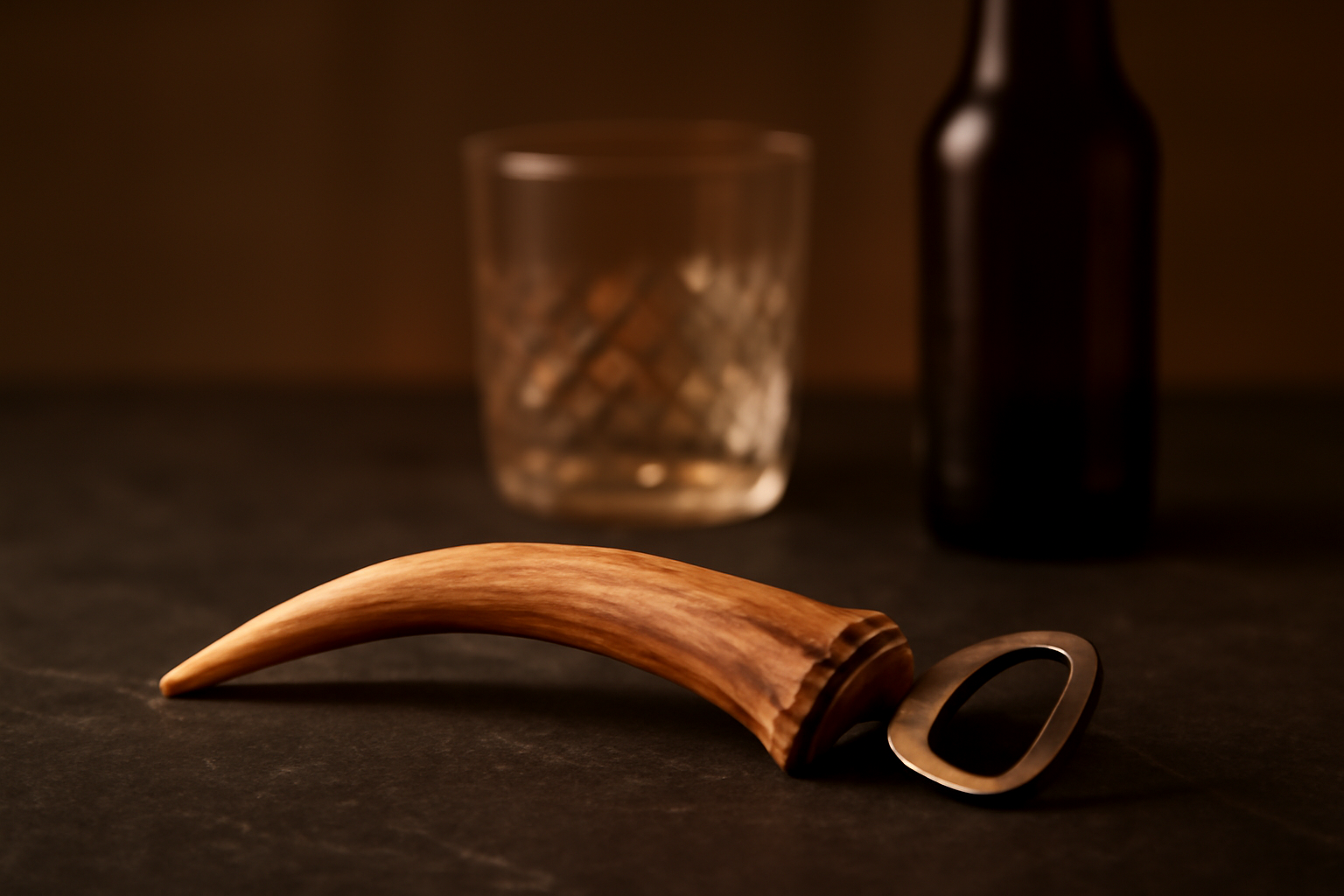
A piece like a handcrafted Antler Bottle Opener, shaped from naturally shed New Zealand red deer antler, isn't just a tool; it's a piece of the landscape and a conversation starter. Antler is an incredible material—dense, durable, and completely unique. No two pieces are the same. Found in the foothills and forests of New Zealand, this material is a sustainable, natural byproduct of the deer's annual cycle. Its organic form provides a naturally ergonomic grip that molded plastic can only imitate. Paired with a robust stainless steel head, it becomes an object that is both beautiful and built to perform for generations.
With just these three manual tools—a waiter’s corkscrew, a Japanese jigger, and a solid bottle opener—you are more than 90% of the way to a fully functional bar. They are the analogue, tactile heart of your setup, leaving you to focus on the last essential ingredients: quality spirits, fresh citrus, and good company.
Embracing this minimalist approach is not about deprivation; it is about elevation. It is the conscious decision to choose a few exceptional, handcrafted tools over a multitude of mediocre, automated ones. It is about understanding that the true luxury in hosting is found in the ritual of the craft, not in the shortcut.
Related reading

Gifting & Occasions· 6 min read
Protecting Garment Linings: The Hardness Scale of Your Key Ring
Why do keys ruin pocket linings? We explore the material science of hardness and friction, and explain how smooth, rounded deer antler offers a fabric-safe, elegant solution.
Read article →
Gifting & Occasions· 6 min read
Stabilizing Dry Seals: Extracting Recessed and Stubborn Wine Corks
Learn the expert technique for extracting dry, recessed, and stubborn wine corks without ruining the wine. Discover how grip and tool design are key to success.
Read article →

Gifting & Occasions· 6 min read
Executive Gift Trends: Why High-Level Partners Prefer Tactile Office Art
Corporate gifting is shifting from plastic tech to tactile office art. We explore why modern executives value functional, analog items that serve as premium desk conversation pieces.
Read article →