
Gifting & Occasions· 6 min read
The Physics of Wine Storage: How Humidity Changes Cork Density
Discover how cellar humidity impacts cork density and the mechanics of extraction. Learn why dry corks crumble and how a well-designed tool can prevent disaster.
By Antler Tree · 1 June 2026
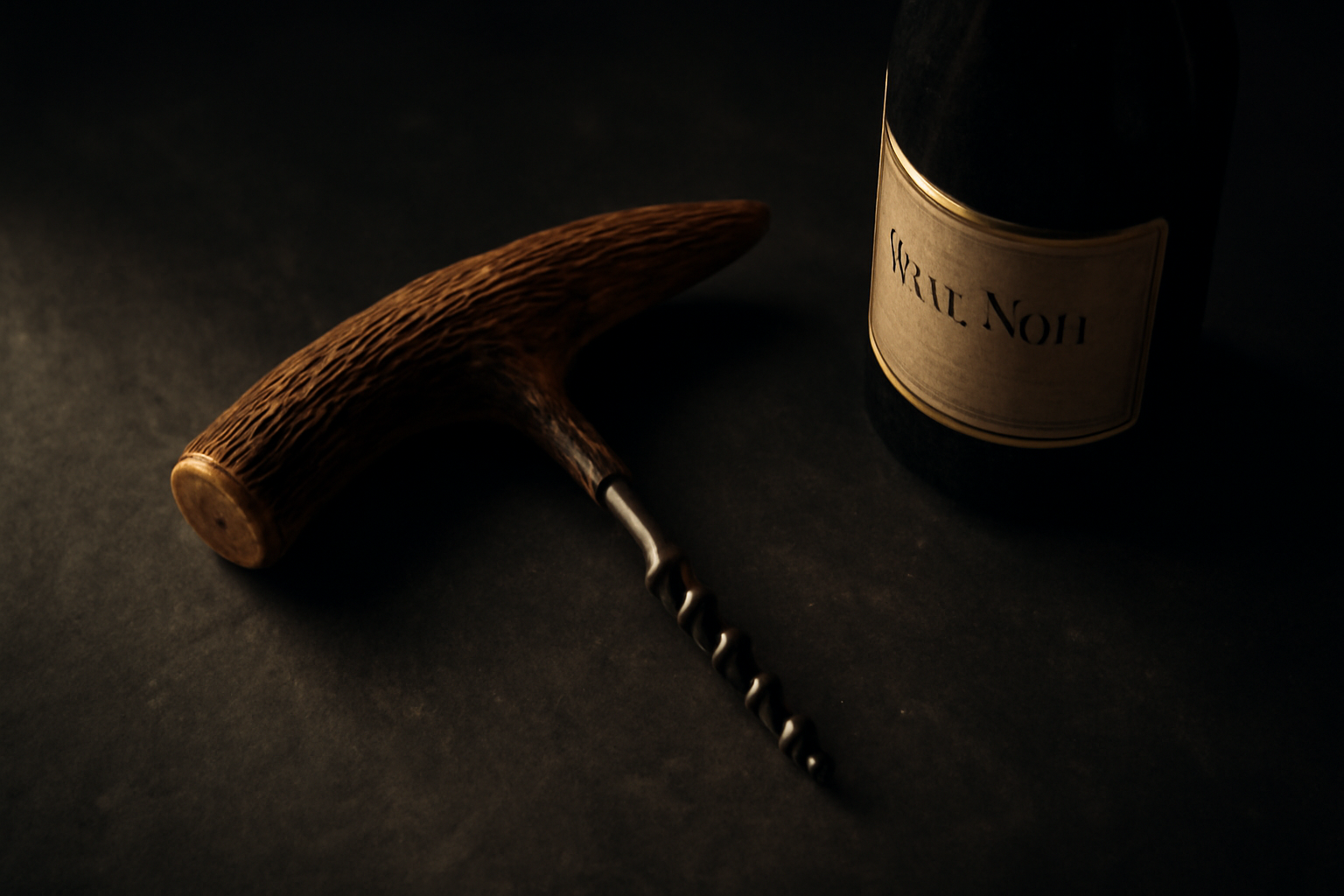
The simple sound of a cork leaving a bottle is a punctuation mark for the day, a small celebration. It is a moment of transition that speaks volumes, not just about the wine to come, but about the journey it has taken. That gentle thump is the sound of success; a crumble of cork into the bottle is the sound of a small, avoidable tragedy rooted in physics.
Beyond the Cellar Door: The Living Nature of Cork
To appreciate the ritual of opening wine, we must first appreciate the material that makes it possible: natural cork. Harvested from the bark of the Quercus suber, or cork oak, this remarkable substance is far more than a simple plug. It is a complex, natural technology refined over millions of years of evolution. Its structure is a microscopic marvel, a matrix of approximately 40 million hexagonal cells per cubic centimetre, each filled with a gas similar to air.
This cellular honeycomb, with walls composed of waterproof suberin and waxy lipids, gives cork its defining qualities: lightness, compressibility, and elasticity. When compressed and inserted into the neck of a wine bottle, it pushes outward, forming a near-perfect seal against the glass. This seal is not static. A healthy cork breathes, allowing for an infinitesimal exchange of gases—a process called micro-oxygenation—that is crucial for the maturation of fine wine. It is a living gatekeeper, moderating the wine's interaction with the world outside.
But like any natural material, cork is subject to the conditions of its environment. It is not an inert, unchanging object but a dynamic component that responds to temperature, pressure, and, most critically, humidity. Understanding this relationship is the key to preserving both the wine and the satisfying experience of opening it.
Humidity's Hidden Influence on Cork Density
The ideal environment for wine storage is often cited as a cool, dark place. Less discussed, but equally important, is the ambient humidity. Natural cork is hygroscopic, meaning it absorbs and releases moisture from its surrounding environment to reach equilibrium. This property is fundamental to its performance over the years or decades a bottle may rest in a cellar.
In a cellar with optimal humidity, typically around 70%, the cork remains in a state of happy equilibrium. As the bottle lies on its side, the wine keeps the interior end of the cork moist. The cellar's humid air keeps the exterior end from drying out. The cellular structure stays plump, hydrated, and elastic, maintaining its outward pressure against the bottle neck. This ensures the integrity of the seal, protecting the wine from excessive oxygen ingress while allowing for the subtle evolution that ageing requires.
Conversely, when a bottle is stored in a dry environment—such as a modern, climate-controlled home with humidity levels often below 50%—the cork begins to suffer. The exposed end of the cork, facing the dry air in the ullage (the space between the wine and the cork), will slowly lose its internal moisture. As the cells dehydrate, the cork itself shrinks C a fractional, but critical, change in volume. It contracts away from the glass, compromising the seal. More pressingly, it loses its elasticity and becomes hard and brittle, setting the stage for a difficult extraction.
The Mechanics of a Difficult Extraction
Opening a bottle of wine should be an act of finesse, not force. The physics of a problematic cork, however, often turns it into a frustrating struggle. The difference between a smooth pull and a disintegrating stopper comes down to mechanical stress and the tool used to apply it.
The Brittle Point: Understanding Shear Stress in Dry Cork
A corkscrew's worm is designed to apply a linear, tensile force—a straight pull along the cork's vertical axis. In an ideal scenario, this force overcomes the friction between the elastic cork and the glass, and the cork slides out intact. However, a dry, desiccated cork behaves very differently under this stress.
Mechanical failure in materials is often about shear stress, a force applied parallel to a surface. A healthy, fully hydrated cork has impressive integrity and can withstand up to 1.2 megapascals (MPa) of shear stress during extraction before its structure is compromised. Its hydrated, elastic cell walls deform, compress, and slide past one another. When a cork dries out, its cellular matrix becomes brittle and fragile. This desiccation can cause its shear strength to plummet dramatically, often falling to as low as 0.3 or 0.4 MPa. When a corkscrew begins to pull, the force is no longer met with elastic resistance. Instead, it encounters a material that can't flex. If the pull is even slightly off-axis, the force becomes a shearing action that the brittle structure cannot withstand. The suberin walls don't bend; they fracture. The cork crumbles at the point of greatest stress, usually where the worm is embedded, leaving a broken plug in the neck.
The Ergonomics of Correction
The ideal of a perfectly vertical pull is a theoretical one. In practice, our hands and arms are not precision machines. We waver, adjust, and apply force that is never perfectly aligned with the bottle's axis. The design of the corkscrew's handle plays a crucial role in how these micro-errors are managed or amplified.
A standard, mass-produced T-handle offers a symmetrical but rigid grip. It forces the user's wrist and hand into a predetermined position, making it difficult to compensate for any slight misalignment. When you pull, any deviation from the vertical is transferred directly to the cork as shear stress.
This is where the unique properties of an organic handle shape become a distinct mechanical advantage. A handle crafted from a piece of naturally shed New Zealand red deer antler, for example, is not symmetrical. Its form is the result of a life lived, with unique curves, textures, and contours. This perceived imperfection is its greatest strength. It allows the hand to find its own natural, neutral grip, a position of both comfort and control. This intuitive connection enables the user to make subtle, subconscious angular corrections during the pull. The organic shape provides tactile feedback, allowing you to sense resistance and adjust your force vector in real-time, guiding the pull back to the centre and minimising the damaging shear forces that would otherwise shred a fragile, older cork.
Choosing the Right Tool for the Material
Given the delicate nature of an aged cork, the tool for its removal should be chosen with care. Brute force, often encouraged by cumbersome winged corkscrews, can be the enemy of a delicate cork. A waiter's friend offers leverage, but the quality of the worm and the feel of the handle are what truly matter. The worm should be sharp, with a wide, open pitch to grip the cork without tearing it, and it should be long enough to embed fully into the stopper.
The handle, however, is your interface with the physics of the task. It is what translates your intent into mechanical force. The tactile feedback from a well-shaped handle is paramount, and the unique form of an Antler Corkscrew provides a grip that is both powerful and sensitive to the needs of the bottle. It is a recognition that a tool need not be sterile and machine-perfect to be effective. In fact, its natural, time-worn form is what makes it a superior instrument for this delicate operation.
Ultimately, opening a bottle of wine is a small ritual that connects us to a time, a place, and a craft. It speaks to a respect for the journey of the wine, from the vineyard to the cellar to the glass. Understanding the humble cork—its life, its vulnerabilities, and the forces that act upon it—is part of that respect. Choosing a tool that honours this material science with its own natural-form-meets-function design completes the circle, ensuring the story of the wine can be enjoyed to its last drop.
Related reading
Gifting & Occasions· 6 min read
Protecting Garment Linings: The Hardness Scale of Your Key Ring
Why do keys ruin pocket linings? We explore the material science of hardness and friction, and explain how smooth, rounded deer antler offers a fabric-safe, elegant solution.
Read article →
Gifting & Occasions· 6 min read
Stabilizing Dry Seals: Extracting Recessed and Stubborn Wine Corks
Learn the expert technique for extracting dry, recessed, and stubborn wine corks without ruining the wine. Discover how grip and tool design are key to success.
Read article →

Gifting & Occasions· 6 min read
Executive Gift Trends: Why High-Level Partners Prefer Tactile Office Art
Corporate gifting is shifting from plastic tech to tactile office art. We explore why modern executives value functional, analog items that serve as premium desk conversation pieces.
Read article →