
Hosting & Entertaining· 6 min read
Extracting Vintage Corks: Navigating Low-Elasticity Closures Successfully
Opening a vintage wine shouldn't be a gamble. Learn why old corks crumble and discover the techniques and ergonomic tools needed for a clean, successful extraction.
By Antler Tree · 1 June 2026
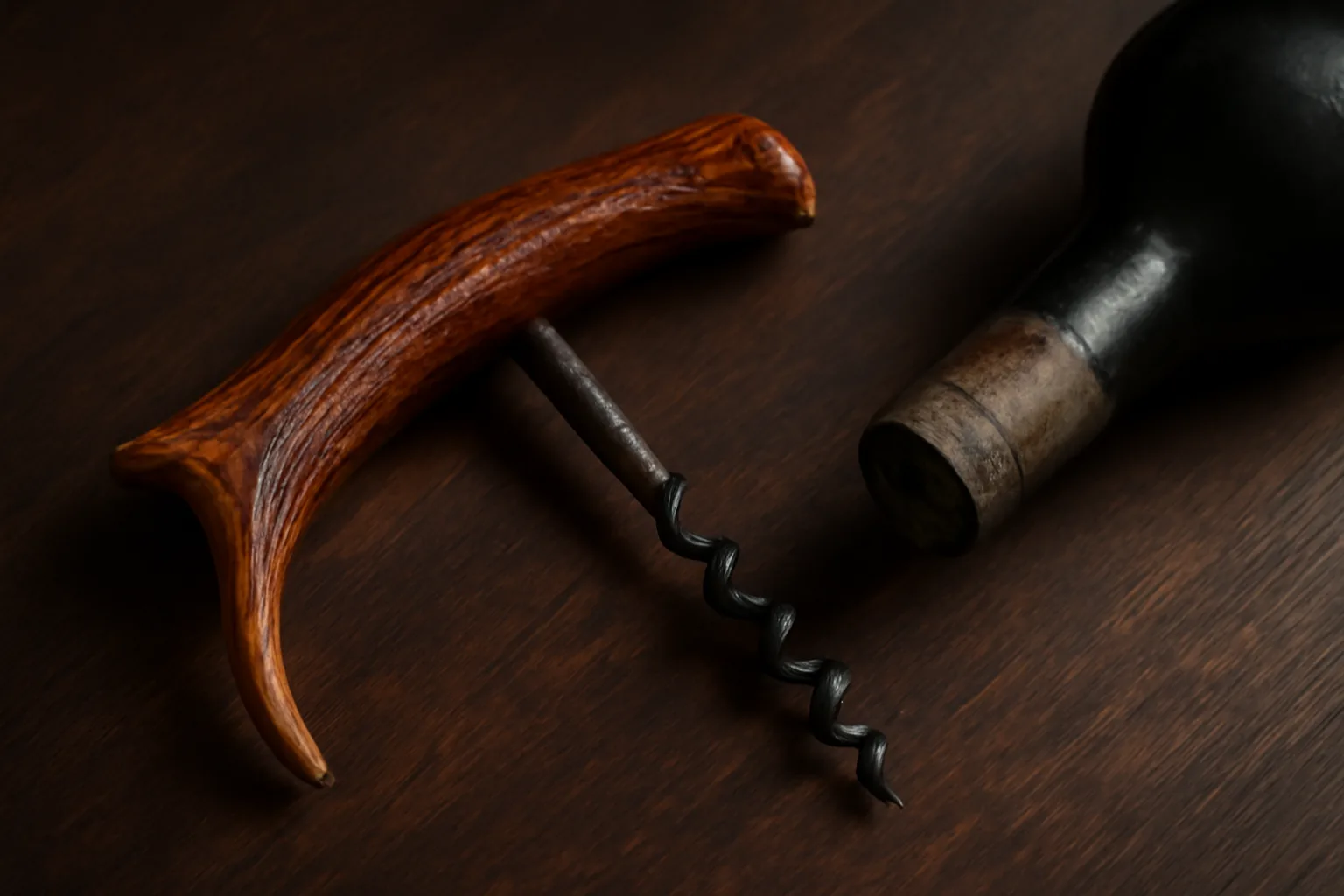
Opening a cherished older bottle of wine should be an act of reverence, not a wrestling match. Yet, the dry, crumbling cork all too often turns ceremony into chaos, leaving a dusty sediment in a wine that has waited patiently for decades. Understanding the material itself, and the forces at play, is the first step toward a consistently clean and successful extraction.
The Graceful Aging and Ungraceful Failure of Cork
To understand why a twenty-year-old cork behaves so differently from a two-year-old one, we must look at its structure. Natural cork is a remarkable material harvested from the bark of the cork oak tree, Quercus suber. Its cell walls are composed mainly of suberin, a waxy, waterproof substance that makes it ideal for sealing a wine bottle. It is this suberin, combined with a matrix of lignin and polysaccharides, that gives a young cork its incredible elasticity. It can be compressed to half its diameter to enter the bottle neck, and then expand to form a tight, impermeable seal.
Over decades, this delicate structure degrades. The primary culprit is oxidation. Though the seal is tight, a minuscule amount of oxygen still interacts with the cork over time. This slow oxidation causes the long-chain molecules of suberin to break down. The cellular structure, once plump and flexible, gradually loses its moisture and its inherent plasticity. The cork becomes brittle, dry, and friable.
The pressure from the glass neck also plays a role. Held in a state of constant compression for years, the cork’s cellular memory fades. It loses its ability to rebound. When you finally attempt to extract it, the material can no longer withstand the torsional and tensile forces applied by a corkscrew. Instead of flexing and holding together, it tears, splits, or disintegrates into a frustrating cascade of granules.
Standard Tools and Their Limitations
Not all corkscrews are created equal, and the tool that works perfectly for a young, robust wine can be the agent of destruction for a vintage bottle. The most common tool, the waiter’s friend, is a marvel of compact engineering but is often poorly suited for this delicate task.
Many standard waiter’s friends feature a short, sharply angled worm—the spiral that inserts into the cork. This design is intended for speed. It bites aggressively into a small section of the cork, concentrating all the pulling force on a few points. On a brittle, low-elasticity cork, this is a recipe for disaster. The worm simply rips a core out of the center, leaving the fragile outer walls to collapse into the bottle.
The other common tool for difficult corks is the ‘Ah-So’ or two-pronged extractor. This tool avoids piercing the cork altogether. Its two thin, flexible blades slide down between the cork and the glass. By rocking and twisting, you can then pull the entire cork out. While effective for corks that are whole but brittle, the Ah-So has its own risk: if the cork is particularly soft or has lost its compression against the glass, the act of inserting the prongs can inadvertently push the entire cork down into the wine.
The Mechanics of a Successful Extraction: Force and Finesse
The goal with a vintage cork is to treat it as a single, fragile unit. This requires distributing the extraction force as widely as possible and applying that force with unwavering control. Two principles are paramount: verticality and the use of a proper worm.
Verticality is Non-Negotiable
Any extraction that involves wiggling, rocking, or pulling at an angle introduces shear stress. Imagine trying to break a dry twig. A straight pull is difficult, but a bending force snaps it instantly. A degraded cork behaves the same way. Shear stress concentrates force along a fracture line, causing the cork to break in half—often leaving the bottom portion stubbornly wedged in the neck.
A perfectly vertical pull, applying force evenly along the cork's central axis, is the only way to minimize this risk. This requires a steady hand and a corkscrew design that facilitates a straight, linear motion.
The Power of the Long Worm
To avoid tearing the center from a brittle cork, you must maximize the corkscrew’s engagement with the material. A long worm, ideally with a shallow pitch (the angle of the spiral), is the solution. A worm of 5cm or more in length can pass almost entirely through the cork. This distributes the tensile load across the entire length of the cork body, rather than just the top third. Furthermore, a worm coated with a low-friction material like Teflon reduces the initial stress of insertion and the resistance during extraction, helping the cork's fragile structure remain intact.
Stabilizing the Hand: Ergonomics and Irregular Forms
Even with the correct technique, the human element can introduce error. Every person has a natural, subtle hand tremor. These micro-movements, while imperceptible in most tasks, are significant when trying to apply purely vertical force. They translate into tiny, unintentional rotations and lateral shifts of the corkscrew, introducing the very shear stress we aim to avoid.
This is where the ergonomics of a handle become critically important. A standard, perfectly cylindrical handle offers very little mechanical resistance to these micro-tremors. Its smooth, uniform surface allows the hand to minutely rotate around the central axis, creating torque that can fracture a fragile cork.
Conversely, an irregular, organic handle—such as one handcrafted from naturally shed New Zealand red deer antler—provides a powerful, passive stabilization system. The non-uniform shape, with its unique curves, swells, and subtle ridges, forces the hand into a more secure, locked grip. Its variable topography, with contact points shifting from 20mm to 35mm along its length, creates a series of natural 'stops' that brace against the small muscles of the palm and fingers. This configuration effectively dampens the amplitude of hand tremors, preventing them from translating into torque on the worm. The organic form compensates for the body's own imperfections.
The larger surface area and textured nature of an antler handle also distribute pressure more evenly across the palm. This reduces grip fatigue, allowing for the slow, steady, and patient pull that an old cork demands. It turns the tool an extension of a steady, confident hand, rather than just a lever.
A Step-by-Step Guide for Vintage Bottles
With an understanding of the material and the mechanics, you can approach an old bottle with confidence.
- Preparation is Key: If the bottle has been stored on its side, stand it upright for at least 24 hours before opening. This allows any fine sediment to settle at the bottom of the bottle.
- Clean and Clear the Neck: Using a cloth, wipe any dust from the top of the bottle. Carefully cut the foil well below the lip of the glass, exposing the top of the cork and the rim. Wipe again to remove any residue.
- Center and Insert with Care: Position the point of the corkscrew directly in the center of the cork. Keeping the tool perfectly vertical, begin turning slowly and deliberately. Do not rush. Drive the worm deeper than you would for a normal cork, ideally until only the last spiral is visible.
- The Slow, Vertical Pull: Brace the bottle with one hand. With the other, begin to pull upward in a single, smooth, and unwavering vertical motion. Avoid any temptation to wiggle or twist the corkscrew back and forth. A well-designed tool, like an Antler Corkscrew with its substantial handle and long worm, provides the necessary leverage and stability for this crucial moment.
- Listen and Feel: As you pull, you may hear the faint sound of the old cork releasing its long-held grip from the glass. Feel for the moment it comes free. The final release should be gentle, not a celebratory 'pop'.
- Have a Backup Plan: If, despite your best efforts, the cork breaks, do not despair. You can attempt to extract the remaining piece with an Ah-So. If it crumbles into the wine, simply decant the wine slowly through a fine-mesh strainer or an unbleached coffee filter into a clean vessel.
Opening an old wine is the final step in a long and quiet journey. It is a ritual that connects us to a past harvest and a specific place in time. Using a tool crafted from a natural, time-honored material like shed antler to release a closure made from another—cork—brings a fitting symmetry to the occasion. It is an act of respect for the wine, the winemaker, and the years of patience held within the bottle.
Related reading
Hosting & Entertaining· 6 min read
The Document Archivist’s Toolkit: Reading Faded Inks and Vintage Print
Discover essential preservation methods for historical documents. Learn to decipher faded inks and vintage print with an archivist's toolkit and techniques.
Read article →
Hosting & Entertaining· 6 min read
The Craft Beer Pour: Why the Opening Ritual Influences Taste Perception
Discover how the ritual of opening a craft beer influences taste. This article explores the physics of a perfect pour and why a quality bottle opener matters.
Read article →
Hosting & Entertaining· 6 min read
Passive Harvesting: The Absolute Peak of Ethical Manufacturing
Explore passive harvesting, a zero-harm model of making. Discover how using naturally shed deer antler offers a profound ethical alternative to resource extraction.
Read article →