Hosting & Entertaining· 6 min read
Passive Harvesting: The Absolute Peak of Ethical Manufacturing
Explore passive harvesting, a zero-harm model of making. Discover how using naturally shed deer antler offers a profound ethical alternative to resource extraction.
By Antler Tree · 1 June 2026
True ethical manufacturing is not about choosing the lesser of two evils or minimizing a negative impact. It is about achieving a state of zero harm, where the very act of creation is in perfect harmony with the natural world. This ideal is not a distant dream; it is a reality practiced in workshops that understand how to listen to and accept the gifts nature willingly provides.
The Rhythm of Shedding: Nature's Gifting Cycle
Every year, in the sprawling wilderness of New Zealand, a quiet and remarkable event takes place. As spring approaches, male red deer (Cervus elaphus) undergo a hormonal shift that causes them to naturally cast off their antlers. This process, known as shedding or casting, is an essential part of the deer's life cycle. The old, heavy bone is discarded to make way for a new, larger set to grow in its place—a testament to the animal's health and vitality.
This is not a painful or stressful event for the deer. The connection point between the antler and the skull, called the pedicle, develops a separation layer. The antler becomes loose and eventually drops off, often dislodged by a gentle knock against a branch or a vigorous shake of the head. The animal, unburdened, moves on. What remains on the forest floor is not a product of harm, but a piece of the wild itself, a beautiful and complex structure grown from the land's own nutrients, from the grass, herbs, and leaves the deer foraged over the preceding months.
These shed antlers are a form of biological surplus. For the deer, their purpose is fulfilled. For the forest ecosystem, they become a vital source of calcium and other minerals, gnawed upon by smaller animals and eventually reclaimed by the earth. But for a brief window, they exist as found objects, intricate sculptures left behind by nature's rhythm. It is from this peaceful, cyclical process that our craft begins, founded on a material that is given, not taken.
From Forest Floor to Maker's Bench: What 'Passive Harvesting' Really Means
The term 'harvesting' often implies an active, extractive process. We harvest crops, timber, or fish. 'Passive harvesting', however, turns this definition on its head. It describes a method of sourcing raw materials that involves no intervention, no disruption, and no harm to the living organism that produced them. In the context of antler, it is the simple, honest act of foraging for what has been freely discarded.
This is the work of shed hunting. It is a slow, patient pursuit that requires an intimate knowledge of the land and the animals that inhabit it. It means walking for miles through rugged hill country, following game trails, and scanning the undergrowth for the distinct curve and colour of a dropped antler. There are no machines, no vehicles churning up the soil. The only tools are a keen eye, a good pair of boots, and a deep respect for the environment.
It is crucial to distinguish this from the active hunting of an animal for its antlers. Passive harvesting takes place long after the deer has shed and moved on. The material is found, not hunted. This distinction is the ethical bedrock of our work. By gathering only naturally shed antler, we ensure that our entire production model is built upon a principle of absolute non-interference with the animal's life. It is a model that honours the creature and its habitat, transforming a remnant of its wild existence into an object of lasting beauty without causing a single moment of distress.
A Tale of Two Materials: The True Cost of 'New' vs. 'Found'
To fully appreciate the elegance of the passive harvesting model, it is useful to contrast it with the standard methods of raw material acquisition that produce most of our everyday objects. The metals, plastics, and even woods we take for granted all carry a significant ecological footprint, a hidden cost that is externalized to the planet. The gather-and-carve model of shed antler craft presents a radically different paradigm.
The Footprint of Extraction
Consider the journey of a common metal object, like a simple steel key or clasp. Its life begins as iron ore, dynamited and excavated from an open-pit mine. This process involves immense environmental disruption. Vast tracts of land, often virgin forest or vital ecosystems, are permanently cleared. The extraction itself is energy-intensive, relying on fossil-fuel-powered heavy machinery to move literal tonnes of earth and rock just to yield a few kilograms of usable ore.
Once mined, the ore is transported—again, using fossil fuels—to a processing plant. There, it is crushed and smelted in blast furnaces reaching temperatures over 1,600°C. This smelting process consumes colossal amounts of energy and releases significant quantities of carbon dioxide and other pollutants into the atmosphere. It also requires vast amounts of water for cooling and processing, which often becomes contaminated with heavy metals and chemical agents, posing a threat to local waterways. The waste product, known as tailings, is a toxic slurry that must be stored in massive ponds, which carry the risk of catastrophic leaks. From land degradation to air and water pollution, the creation of a 'new' material from the ground up is an inherently violent and costly process.
The 'Footprint' of Gathering
Now, trace the journey of a piece of shed antler. The material's creation is powered entirely by the sun, converted into plant matter, and consumed by a deer. The deer's own biological systems—its metabolism—do the work of synthesis, forming the dense calcium phosphate structure of the antler. This is a quiet, solar-powered, biological manufacturing process that is perfectly integrated into its ecosystem.
Our sourcing process—the 'extraction'—is a human walking through the forest. The energy consumed is a few hundred calories of breakfast. The 'machinery' involved is a pair of hiking boots. The impact on the land is a fleeting footprint in the mud. No soil is displaced, no habitats are destroyed, no water is polluted, and no carbon is released. The material is found in its pure, finished state, needing only to be cleaned and carved. The only byproducts are a deeper connection to the wilderness and a trove of stories about the day spent searching. It is a one-to-one relationship between a person and a material, with the natural world as a silent, unharmed partner.
The Inherent Qualities of a Wild Material
Beyond its unparalleled ethical credentials, shed antler is a uniquely beautiful and meaningful material. Unlike a uniform, mass-produced substance, each piece of antler is an individual artifact, a physical record of an animal's life. The colour, density, and texture are all influenced by the deer's age, its diet, and the specific environment it roamed.
A piece of antler found in the deep shade of a beech forest might be dark and stained by tannins from the leaf litter. One found on a sun-exposed tussock hillside might be bleached almost white, weathered by wind and rain. The 'coronet' at the base is rugged and intricate, while the tip is dense and smooth. These are not imperfections; they are marks of authenticity, textures that tell a story of place and time.
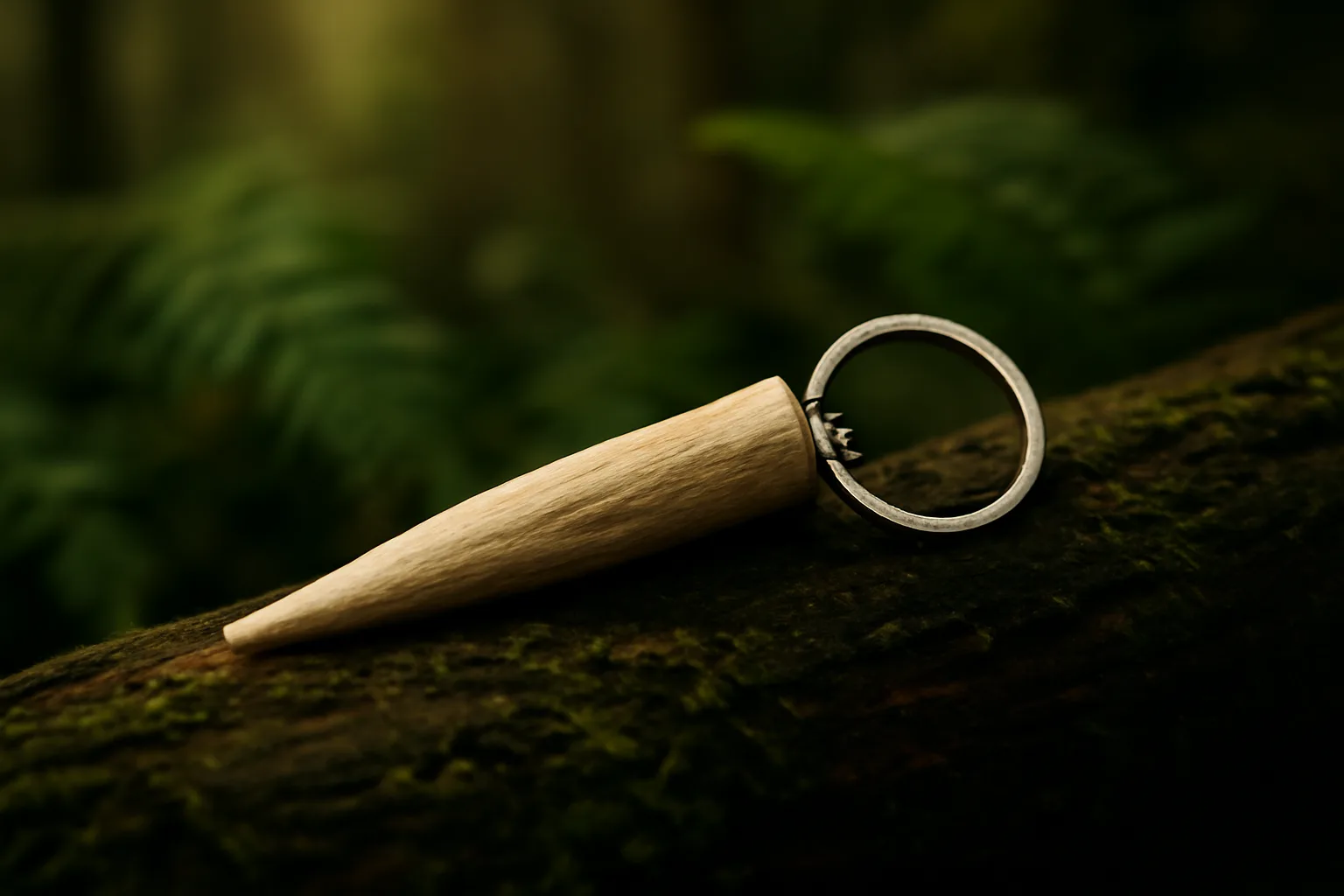
Working with this material is a process of discovery. As we cut and shape each piece, we reveal qualities hidden within. The dense inner bone polishes to a finish that is warm and smooth, feeling almost alive in the hand. This tactile connection to a wild and natural object is profound. To carry a small, functional piece of this story with you every day is a quiet reminder of a world beyond the manufactured. Even in a simple object like a handcrafted Antler Key Ring, the weight, texture, and history of the material provides a grounding and beautiful experience.
Craft as Stewardship
The responsibility of the ethical maker does not end with sourcing. The respect shown for the material on the forest floor must continue at the workbench. Our approach to craft is one of stewardship. We aim to use every possible part of the antler, minimizing waste and honouring the gift we have been given. The shapes we carve are often dictated by the natural curves and forms of the antler itself, working with its inherent character rather than imposing a foreign design upon it.
The workshop is not an industrial factory but a quiet space for careful work. We use simple tools and low-impact techniques. The process is slow and deliberate, a conversation between the maker and the material. This philosophy ensures that the purity of the antler's origin is preserved throughout its transformation, resulting in a finished piece that is as honest and authentic as the wild place from which it came.
Passive harvesting is more than just a sourcing strategy; it is a philosophy. It demonstrates that it is entirely possible to create objects of exceptional quality and beauty without ecological compromise. By aligning our creative process with the gentle, regenerative cycles of the natural world, we embrace a model of production that is not just sustainable, but truly restorative. It is a testament to the idea that the most beautiful things are not those we force from the earth, but those we humbly accept from it.
Related reading

Hosting & Entertaining· 6 min read
The Document Archivist’s Toolkit: Reading Faded Inks and Vintage Print
Discover essential preservation methods for historical documents. Learn to decipher faded inks and vintage print with an archivist's toolkit and techniques.
Read article →

Hosting & Entertaining· 6 min read
The Craft Beer Pour: Why the Opening Ritual Influences Taste Perception
Discover how the ritual of opening a craft beer influences taste. This article explores the physics of a perfect pour and why a quality bottle opener matters.
Read article →
Hosting & Entertaining· 5 min read
Sizing and Scale: Selecting Statement Pendants for Your Silhouette
Learn how to select the perfect statement pendant. Our guide covers matching necklace length to necklines and using organic shapes to flatter your silhouette.
Read article →