Craft & Materials· 6 min read
Haptics in Your Pocket: Why Everyday Carry (EDC) is Turning to Nature
Investigating the trend of organic micro-textures in EDC. Learn how natural materials like antler offer more than grip—they act as passive stress-relief tools.
By Antler Tree · 1 June 2026
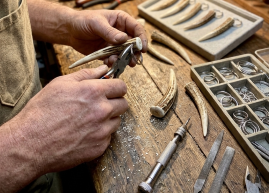
The objects we choose to carry every day are becoming more than just functional. There is a quiet movement away from the cold, sterile uniformity of metal and plastic toward materials with life, character, and a story held in their very surface. This shift is not merely aesthetic; it is a deep, sensory-driven response to an increasingly digital world.
The Smoothness Fallacy
For decades, premium design was synonymous with sleek, uninterrupted surfaces. From the chrome gleam of mid-century furniture to the polished glass of a smartphone, smoothness communicated precision, modernity, and a clean, machine-made perfection. In many applications, this makes sense. But for objects designed for the hand—the everyday carry (EDC) tools that live in our pockets and palms—this pursuit of smoothness has revealed a fundamental flaw. It creates sensory monotony.
The human hand is an incredibly sophisticated sensory organ, yet we have increasingly given it objects that offer no information. A perfectly smooth surface offers a single, unchanging datapoint. It can feel slick, cold, and surprisingly fatiguing to hold. Early attempts to solve this within the EDC community focused purely on mechanical grip: aggressive checkering on knife scales, sharp knurling on flashlight bodies. These textures prevent slipping, but they are often as uniform and repetitive as the smoothness they replaced. They shout at the nerves, providing a functional but abrasive experience.
The current evolution in design acknowledges a more subtle truth: the hand does not just want to grip, it wants to feel. It craves variety, warmth, and the kind of complex micro-textures that engage the mind in a gentle, persistent dialogue. This is where nature re-enters the conversation, bringing with it materials shaped by life, not by a lathe.
The Brain in Your Palm: Natural Textures as Cognitive Fuel
The profound satisfaction of running a thumb over wood grain or feeling the intricate bumps of an antler coronet is not just a pleasant sensation. It is a neurological event with roots in environmental psychology and cognitive science. The key lies in how our brains process sensory information and manage attention.
Psychologists Rachel and Stephen Kaplan developed Attention Restoration Theory (ART), which posits that our ability to focus (directed attention) is a finite resource. It’s easily depleted by the demands of modern life: traffic, deadlines, and the constant digital alerts from our devices. To recharge, we need experiences that evoke “soft fascination.” Unlike the “hard fascination” of a video game or thriller, which hijacks our attention, soft fascination gently holds it without effort. Classic examples are watching clouds drift or a fire flicker. This state allows our directed attention to rest and replenish.
This is precisely what happens on a micro-scale when we touch a natural, non-uniform texture. The surface of a piece of shed antler, for instance, is a landscape of fractal patterns—complex, self-repeating shapes that are the mathematical signature of the natural world. Research has shown that humans are hard-wired to find these patterns calming. When your fingers trace these organic, unpredictable lines and bumps, your brain receives a constant, low-level stream of novel sensory data. It is just engaging enough to occupy the mind without demanding cognitive resources. This passive engagement can help quiet the brain’s “default mode network,” the part associated with anxious rumination, and tether your awareness to the present moment.
Studies have linked exposure to natural patterns and textures with tangible physiological benefits, including a reduction in the stress hormone cortisol and a lower heart rate. A smooth, sterile object is processed and dismissed by the brain in an instant. A naturally textured object acts as a subtle, persistent grounding tool. It’s a quiet fidget object that doesn’t require active thought, offering a small dose of restorative, sensory nutrition every time you reach into your pocket.
Material Stories: The Rise of Organic EDC
This innate need for sensory richness is driving a renaissance in material choice for pocketable goods. Designers are turning away from inert polymers and coated alloys and embracing materials that carry the imprint of their origin.
- Stabilized Wood: Woods like buckeye burl or curly maple offer stunning visual depth and a grain that provides a unique tactile map. The stabilization process infuses the wood with resin, making it durable enough for daily use while preserving its organic character.
- Micarta and G-10: These composite materials, made from layers of fabric (like linen or canvas) set in resin, provide a warm, grippy texture that wears in over time, revealing the weave of the underlying fabric.
- Leather: A timeless choice, leather offers a warm, supple feel that conforms to the hand. Its greatest appeal is its patina, as it darkens, softens, and molds to its user, becoming a unique record of its journey.
Antler: A Case Study in Haptic Uniqueness
Among these materials, naturally shed deer antler holds a special place, particularly the antler from New Zealand’s magnificent red deer. It is not a single texture, but a spectrum of sensations on one contiguous piece. The base, or coronet, features a rough, gnarled texture—a dense cluster of “pearls” that provides exceptional grip and a complex surface for the thumb to explore. Further up the beam, the surface becomes smoother, but is still punctuated by shallow grooves and a subtle, porous feel.
Unlike metal or plastic, antler is a bone material. It warms quickly to body temperature, losing the cold, alien feel of inorganic materials. This combination of thermal warmth and textural complexity offers a rich sensory experience that is both grounding and deeply satisfying. This profound feedback is why a piece as seemingly simple as a handcrafted Antler Key Ring can become a source of quiet contemplation, a small anchor to the natural world that lives in your pocket. It is a reminder of wild, open spaces, of a sustainable cycle of growth and renewal.
From Pocket Tool to Personal Totem
As our tools embrace these living materials, their role begins to shift. A knife is no longer just a cutting tool, and a keychain is not just for holding keys. They become personal totems—objects imbued with meaning that extends beyond their function. They are grounding objects that we connect with through touch.
The most compelling aspect of this is how these materials age. A plastic handle scratches and fades, its story one of degradation. A coated metal flashlight chips and wears, revealing the cheaper material beneath. But an antler handle, a wooden scale, or a leather sheath develops a patina. The oils from your hand smooth and polish certain areas, deepening the color and highlighting the texture. The object doesn’t just wear; it matures. It becomes a collaboration between the natural material and the person who carries it, with each mark and subtle change in luster telling the story of its use.
This process of aging gracefully forges a powerful bond between user and object. It becomes uniquely yours, a repository of time and touch. In a culture saturated with disposable goods, choosing an object that improves with age is a quiet act of defiance and a commitment to lasting value.
Ultimately, the migration toward natural textures in our everyday items is a search for connection. It is a recognition that the things we touch most frequently should offer more than just cold utility. They should provide sensory comfort, a moment of cognitive peace, and a tangible link to the organic world we too often hold at a distance. Take a moment to consider the objects in your own pocket; their story, and the way they feel in your hand, may be more important than you think.
Related reading
Craft & Materials· 6 min read
Patio Hosting Mechanics: Selecting Slip-Resistant Tools for Summer Barbecues
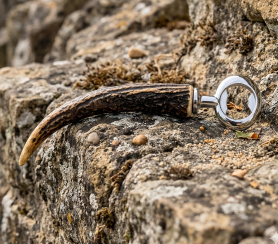
A guide to high-durability, slip-resistant barbecue tools. We analyze why natural antler grips better than polymer in wet conditions for confident patio hosting.
Read article →

Craft & Materials· 6 min read
Replacing Greenwashed Corporate Swag with Genuinely Sustainable Luxury
Tired of disposable corporate swag? Discover how naturally shed deer antler offers a truly sustainable, carbon-neutral luxury gift that lasts a lifetime.
Read article →
Craft & Materials· 6 min read
The Psychology of Hosting: How Weighty Bar Tools Change the Guest Experience
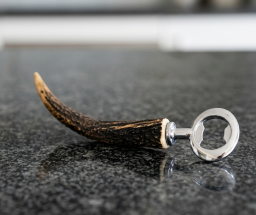
Discover the psychology of hosting. We break down the weight-value heuristic, revealing how the heft of quality bar tools subconsciously signals value to your guests.
Read article →