Hosting & Entertaining· 5 min read
Sizing and Scale: Selecting Statement Pendants for Your Silhouette
Learn how to select the perfect statement pendant. Our guide covers matching necklace length to necklines and using organic shapes to flatter your silhouette.
By Antler Tree · 1 June 2026
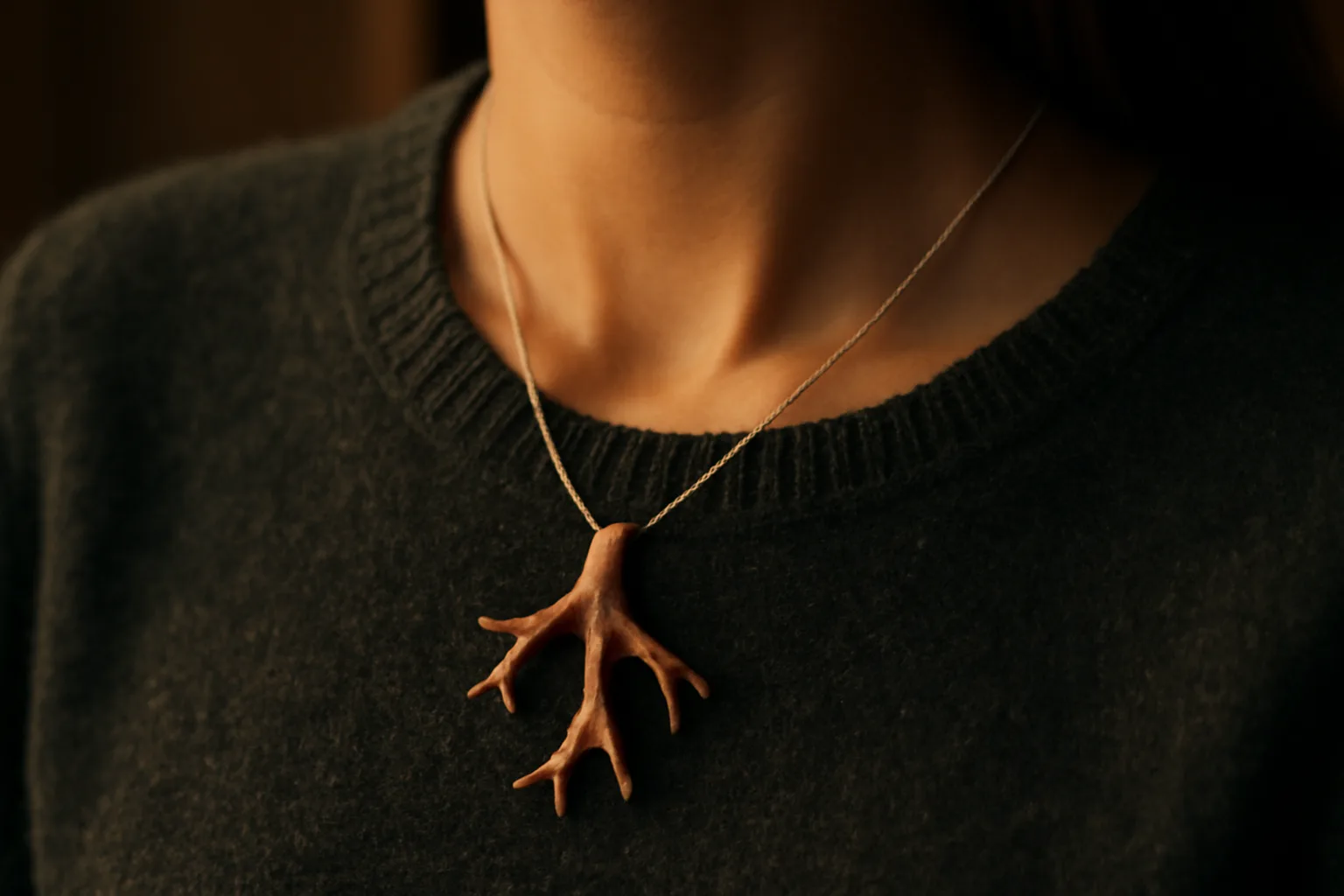
A piece of jewellery worn close to the heart should be more than an afterthought; it should be an anchor. Choosing a statement pendant is less about following fleeting trends and more about understanding the silent conversation between form, material, and your own silhouette.
The Principle of Proximity: Necklines and Drop Lengths
The most fundamental element of selecting a necklace is its length, or 'drop'. The goal is to create harmony between the pendant's resting place and the neckline of your garment. A pendant that competes with the fabric's edge creates visual static, drawing the eye to the awkward intersection rather than to the piece itself.
Consider these pairings as foundational guidelines:
-
Crew & High Necks: For turtlenecks, mock necks, and classic crewnecks, longer chains are your strongest ally. A pendant that falls at or below the bust line (typically 28-36 inches) creates a powerful vertical line, elongating the torso. It operates in its own space, free from the neckline's boundary.
-
Scoop & U-Necks: These open necklines provide a perfect frame. The key is to mirror the curve. A shorter chain (18-20 inches) that allows the pendant to rest a few centimetres above the fabric hem creates a beautiful, nested effect. The open skin becomes the canvas for the piece.
-
V-Necks & Collared Shirts: V-necks naturally guide the eye downward, making them an ideal partner for pendants. Choose a length that allows the pendant to sit centrally in the 'V' of skin, without touching the fabric. For a button-down shirt, you have two options: a shorter 16-18 inch chain worn with the top one or two buttons undone, or a much longer chain worn over the closed shirt, creating a confident, layered statement.
-
Boat Necks & Off-Shoulder: These necklines create a strong horizontal line across the collarbones. A pendant here can feel adrift. The most elegant solution is often to forego a necklace or, for a bolder look, to choose a very long chain that creates a dramatic counterpoint to the horizontal sweep of the fabric.
The Negative Space Rule
A simple rule to remember is to preserve negative space. The skin between the bottom of your pendant and the top of your garment is just as important as the piece itself. Aim for at least two to three centimetres of clearance. This breathing room ensures the pendant is presented as a distinct object of focus, not as an extension of your clothing. When a pendant perpetually sits right on the fabric edge, it looks indecisive. Give it a home, either clearly on the skin or clearly on the garment.
Calibrating Scale: Pendant Size and Your Silhouette
Once you have determined the optimal length, the next consideration is scale. How large should a 'statement' pendant truly be? Simplistic advice often ties pendant size directly to body frame, but this misses the nuance of visual weight and intention. A statement piece is, by definition, meant to draw the eye. The question is not just about balance, but about what you wish to accentuate.
A larger, more substantial pendant will naturally become a primary focal point. On a smaller frame, this can be a deliberate and powerful choice, creating a dramatic anchor for an entire outfit. Conversely, a delicate pendant on a larger frame can communicate a quiet confidence and attention to fine detail.
Instead of a rigid set of rules, think in terms of visual dialogue. A heavy, rustic knit sweater can carry a larger, more textural pendant, as they speak a similar language of substance and craft. A fine silk blouse, however, might be better served by a piece with more moderate proportions, allowing the fabric's own lustre to share the stage. Consider the visual density of your entire look, and choose a pendant that either complements or intentionally contrasts with it.
The Organic Advantage: Embracing Natural Asymmetry
In the world of jewellery, we are often conditioned to seek perfect symmetry. A circular disc, a square gemstone, a flawless teardrop—these forms are beautiful but unforgiving. Their geometric purity demands perfect placement. When a symmetrical pendant shifts even slightly off-centre against the sternum, the human eye, which is masterful at detecting pattern and deviation, immediately registers the imbalance. This can create a subtle, persistent feeling of being askew.
This is where the structural genius of natural forms comes into play. A piece carved from a material like naturally shed New Zealand red deer antler possesses inherent, organic asymmetry. It has no perfect, mathematical centreline. This is its greatest strength.
Let’s call this the Principle of Forgiving Form. Consider a perfectly round 40mm medallion. If it shifts just 5mm to the left or right, it breaks the expected alignment with your body's vertical axis. The error is obvious. Now, consider an antler tip of a similar scale. Its form might have a primary curve, a fork, and subtle texturing along its length. Its visual 'weight' is distributed unevenly across multiple points of interest. If this piece shifts 5mm, it doesn't appear 'wrong'. Instead, it presents a slightly different, but equally valid, composition. The eye doesn't see a flaw; it simply follows a new path along the object's contours.
The mechanism is one of diffused focus. A symmetrical pendant creates a single, sharp focal point. An organic pendant creates a field of interest. Its irregular lines and natural textures invite the eye to wander rather than to judge its position. This quality makes it exceptionally comfortable and effortless to wear. It works with the body's natural movement, not against it, settling into a new, harmonious position with every shift. It liberates the wearer from the quiet anxiety of constant adjustment.
Choosing Your Form: Material and Meaning
Every pendant carries a story, told through its shape and substance. Geometric shapes—circles, squares, triangles—speak of order, modernity, and human design. Their clean lines can feel crisp and architectural.
Organic forms, however, connect us to the world outside. A piece crafted from a found material is imbued with a sense of place and history. It is a tangible link to a more wild and untamed narrative. The unique, branching form of a handcrafted Antler Necklace carries a story of the New Zealand high country, of seasons turning, and of life's cycles. Each piece is, by its very nature, one of a kind, shaped by the life of the deer from which it was shed.
This is not merely an aesthetic choice; it’s a choice of philosophy. To wear a piece of polished antler is to value provenance and sustainability. It is an appreciation for an object whose beauty was not manufactured from raw ore, but was grown, shed naturally, and respectfully gathered. Its warm, tactile quality and bone-like grain feel fundamentally different against the skin than cold metal. It holds a warmth that speaks to its biological origin, making it a uniquely personal and grounding object to wear.
Ultimately, selecting a statement pendant is an act of curation. You are not just decorating your body; you are adding a layer of meaning and providing a focal point that structures your entire look. By understanding the interplay of length, scale, and the profound power of natural asymmetry, you can choose a piece that feels less like an accessory and more like a personal emblem.
Related reading

Hosting & Entertaining· 6 min read
The Document Archivist’s Toolkit: Reading Faded Inks and Vintage Print
Discover essential preservation methods for historical documents. Learn to decipher faded inks and vintage print with an archivist's toolkit and techniques.
Read article →
Hosting & Entertaining· 6 min read
The Craft Beer Pour: Why the Opening Ritual Influences Taste Perception
Discover how the ritual of opening a craft beer influences taste. This article explores the physics of a perfect pour and why a quality bottle opener matters.
Read article →
Hosting & Entertaining· 6 min read
Passive Harvesting: The Absolute Peak of Ethical Manufacturing
Explore passive harvesting, a zero-harm model of making. Discover how using naturally shed deer antler offers a profound ethical alternative to resource extraction.
Read article →