
Hosting & Entertaining· 6 min read
Pocket Auditing: Streamlining Your Daily Key Carry System
Tired of bulky, jingling pockets? Our guide to pocket auditing helps you streamline your key carry with a weight-to-volume framework for functional simplicity.
By Antler Tree · 1 June 2026
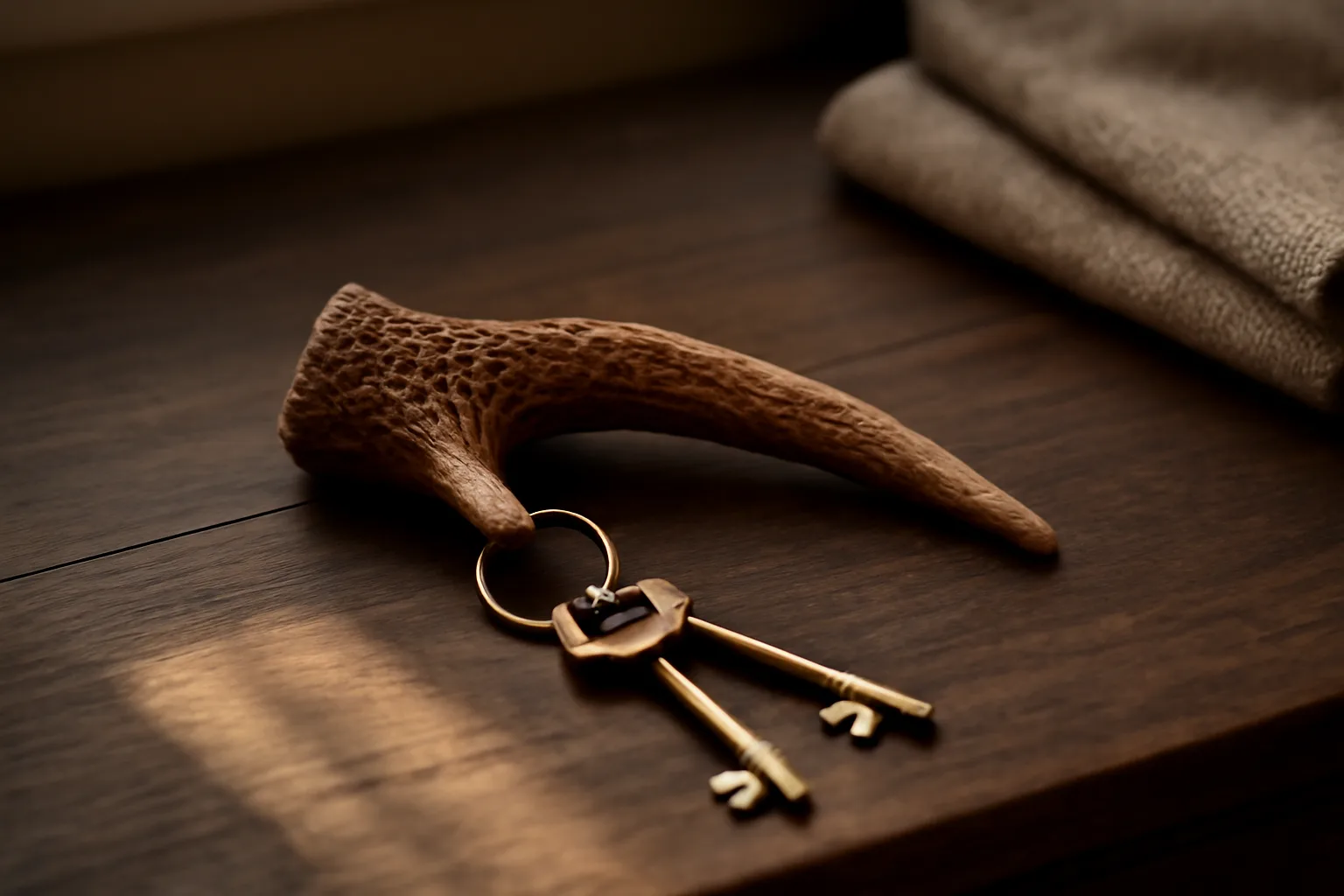
The sound of a day beginning is often the jingle of keys in a pocket or the clatter of them on a counter. This constant, metallic chatter is such a common part of our lives that we rarely stop to question it. Yet our pockets, the most immediate and personal spaces we carry, deserve the same thoughtful curation we give our homes.
The Unexamined Pocket
Over time, our keyrings become unintentional archives of our lives. They are burdened with keys to locks long since changed, mailboxes for previous addresses, and mystery keys we hold onto 'just in case'. This phenomenon, which we might call ‘key creep,’ is a slow accumulation of metallic obligations. Each addition seems insignificant on its own, but together they create a system of disarray that we carry everywhere.
The cost is more than just the jangling noise. A heavy, bulky set of keys creates a tangible drag. It wears unnaturally on the fabric of our trousers and jackets, creating unsightly bulges and, eventually, holes. It pulls on the ignition of our cars. In a bag, it sinks to the bottom, forcing a frustrating rummage every time we arrive at a door. This physical weight is accompanied by a subtle cognitive load—a small, persistent reminder of unresolved clutter.
Most keychains are little more than metal rings, devoid of character and designed purely for function. They contribute to the chaotic jumble rather than solving it. A disorganised keychain is a missed opportunity for elegance and efficiency. By auditing what we carry every day, we can transform a source of minor friction into a point of quiet satisfaction.
A Framework for the Pocket Audit
To reclaim this personal space, we need a simple, effective method. A pocket audit is not about ruthless minimalism for its own sake; it is an act of curation. The goal is to create a system that is lighter, quieter, and more intentional, centred around a single object that provides sensory satisfaction. This involves two core principles: analysing the weight-to-volume ratio of what you carry and consciously replacing chaotic noise with a singular, tactile anchor.
Analysing Weight-to-Volume
At its heart, the problem of a bulky keychain is one of physics. Each key is a small, dense object. A standard brass house key (like a Schlage C profile common in New Zealand) weighs approximately 10 grams and has a volume of just over 1 cubic centimetre. Its weight-to-volume ratio is high. When you carry five, six, or more of these dense objects, they knock against each other, creating noise and a concentrated, uncomfortable mass.
The audit process is straightforward:
- Gather and Inventory: Place every key and accessory from your keyring onto a flat surface. This includes house keys, car keys, office keys, shed keys, loyalty tags, and fobs.
- Identify Essentials: Separate the keys you use on a daily or near-daily basis. For most people, this is a house key and a car key. These are your non-negotiables.
- Assess the Periphery: Now, look at the remaining keys. For each one, ask: “How often have I used this in the last three months?” Be honest. A key to a friend's house you visit twice a year does not need to live in your pocket. Likewise for the key to a parental home, a storage unit, or a rarely used padlock.
- Relocate or Eliminate: Find a designated, accessible home for these secondary keys—a hook inside a cupboard, a specific dish on a dresser, or a labeled organiser. For keys that are truly obsolete, recycle them. Consider digital solutions where practical; a keypad lock on a garden shed, for example, eliminates a physical key entirely.
Let’s consider a practical example. A keychain holds seven assorted brass and steel keys, weighing a total of 75 grams. The audit reveals that only two house keys and one car key fob are daily essentials. The remaining four keys—for a shed, a mailbox, a parent's home, and an old padlock—are relocated. The daily carry weight is now reduced to approximately 35 grams, a reduction of over 50%. The bulk is similarly halved, and the potential for jingling is drastically diminished.
Preserving a Sensory Anchor
The purpose of this audit is not to create a sterile, purely functional tool. In removing the chaotic sensory input of clashing metal, we create space for a single, intentional sensory experience. Humans are tactile creatures. The feel of a smooth stone, a piece of worn wood, or the grain of leather in our hand can be grounding. Your daily key carry should include one such object—a focal point that replaces clutter with character.
This 'sensory anchor' elevates the entire assembly from a mere collection of keys to a curated personal item. It is the piece you feel for in your pocket, its distinct shape and texture a quick, reliable landmark. It should have a pleasant weight and a material quality that feels good to hold. This is where the choice of keyring itself becomes paramount. It is no longer just a ring but the heart of your new, streamlined system.
Choosing Your Focal Point
The market for key organisers is vast, but most options fall into a few categories. Metal multi-tools can be efficient but are often cold, hard, and overly complex. Leather loops and fobs are warmer but can stretch and wear over time. Simple steel rings serve their purpose but offer no tactile reward or aesthetic value. The ideal focal point is something different—an object that balances robust function with natural beauty.
It should be crafted from a material that tells a story and engages the senses. An object that connects you to the natural world, like a handcrafted Antler Key Ring made from naturally shed New Zealand red deer antler, offers a unique warmth and texture that sterile metal or plastic cannot replicate. Each piece of antler is unique, with its own coronet shape, colour, and grain developed over a lifetime in the wild. It has a satisfying heft without being heavy, and its organic form feels naturally settled in the palm of your hand.
When selecting your focal point, consider these qualities:
- Material: Does it come from a natural, sustainable source? Does it have a texture that will gain character with age?
- Form: Is it comfortable to hold? Is its shape distinct enough to be easily found by touch?
- Craft: Is it made with care? An object you handle every day should be well-constructed and feel solid and dependable.
By choosing one beautiful, functional piece, you are not just organising your keys; you are elevating a mundane daily interaction into a moment of quiet appreciation for good design and natural materials.
The Art of the Carry
With your keys audited and your focal point chosen, the final step is to establish the new routine. The lightness and compactness of your new set may be surprising at first. It will sit more comfortably in a pocket, no longer a jagged lump but a smooth, cohesive unit.
The tactile nature of a piece like an antler keyring makes it easier to locate. Instead of fumbling for a mess of metal, your hand instinctively finds the familiar, organic shape. This is true whether it’s in the bottom of a deep tote bag or in the small coin pocket of a pair of jeans. It becomes a landmark.
This refined approach to carrying our keys reflects a broader philosophy. It is about bringing intention to the small, overlooked corners of our lives. It is a belief that the tools we use daily should be both beautiful and functional, connecting us to a world of genuine craft and natural materials. An antler, shed naturally in the high country of New Zealand, is a perfect embodiment of this idea—a piece of the wild, shaped by hand into a simple, elegant tool to accompany you on your daily journey.
By taking a few moments to audit your pocket, you trade the constant, low-grade annoyance of clutter for a system of elegant efficiency. You replace the noise of clashing metal with the satisfying, quiet weight of a single, well-chosen object. It is a small change, but one that refines your daily experience, leaving you with a sense of calm, order, and connection every time you reach for your keys.
Related reading

Hosting & Entertaining· 6 min read
The Document Archivist’s Toolkit: Reading Faded Inks and Vintage Print
Discover essential preservation methods for historical documents. Learn to decipher faded inks and vintage print with an archivist's toolkit and techniques.
Read article →

Hosting & Entertaining· 6 min read
The Craft Beer Pour: Why the Opening Ritual Influences Taste Perception
Discover how the ritual of opening a craft beer influences taste. This article explores the physics of a perfect pour and why a quality bottle opener matters.
Read article →
Hosting & Entertaining· 6 min read
Passive Harvesting: The Absolute Peak of Ethical Manufacturing
Explore passive harvesting, a zero-harm model of making. Discover how using naturally shed deer antler offers a profound ethical alternative to resource extraction.
Read article →