
Lifestyle & Home· 6 min read
Reading the Past: How Antique Map Collectors Verify Engraving Details
Explore an expert's guide to verifying antique maps. Learn non-destructive methods for analyzing paper, ink, and watermarks to uncover a document's true history.
By Antler Tree · 1 June 2026
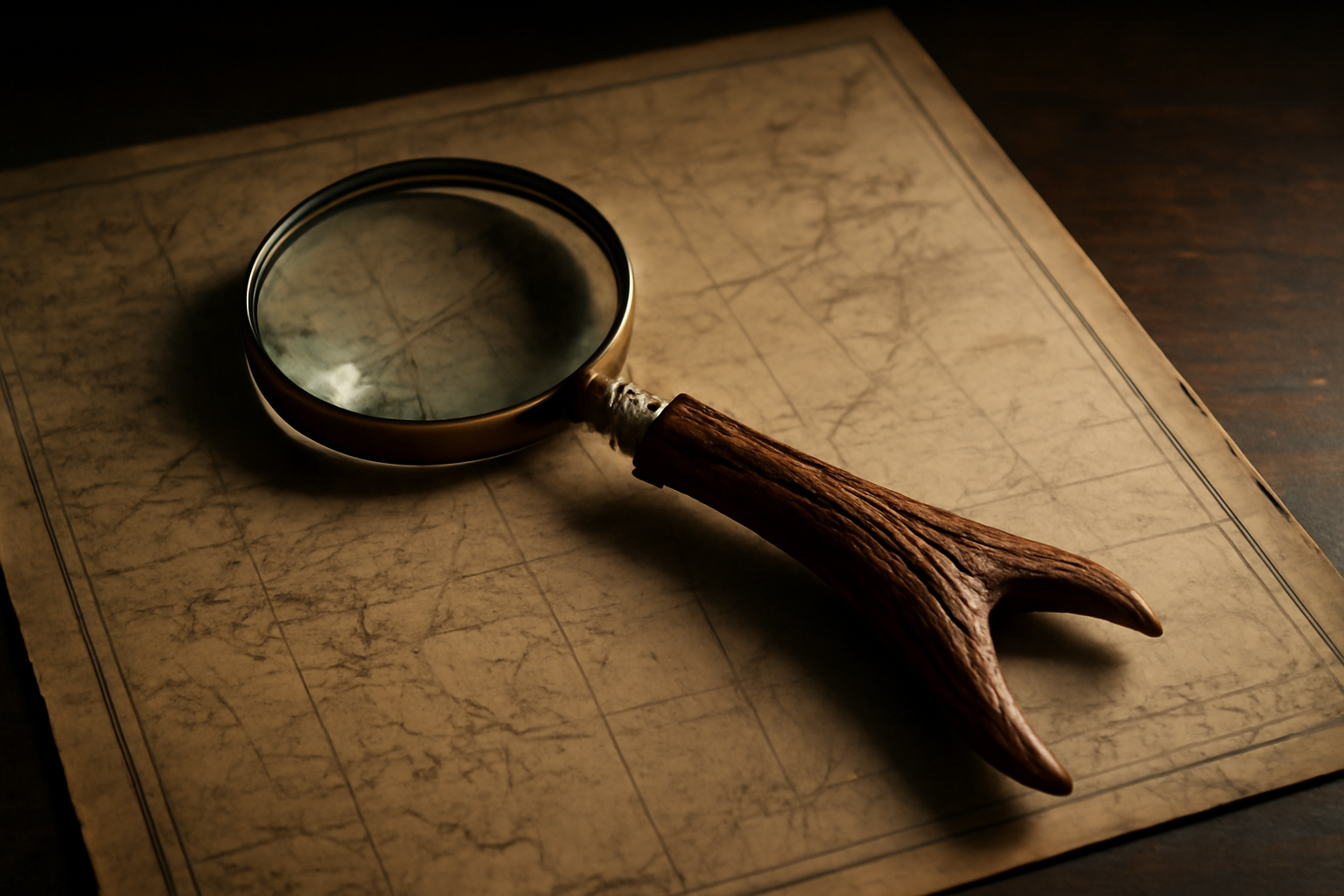
A beautiful old map is more than a piece of decoration; it is a document of human ambition, a testament to a time when the world felt both larger and less known. To truly appreciate one is to look past its surface and learn to read the subtle language of its creation. Understanding the story held within the paper, ink, and craftsman’s marks is a tactile pursuit, one that connects us directly to the past.
The Language of Old Paper
Before the 19th century, paper was not the wood-pulp product we know today. It was a textile, meticulously crafted from cotton and linen rags. This rag paper has a distinct character that sets it apart from modern facsimiles. When you handle an authentic period map, you can feel this difference. The paper is often softer, more flexible, and possesses a tangible warmth and depth. Modern, wood-pulp paper, especially when artificially aged, tends to be stiffer and more brittle, lacking the supple quality of its rag-based ancestor.
Run your fingers gently over the surface—not the printed side, but an un-inked margin. You may feel a subtle, irregular texture. This is the ghost of the papermaker’s mould, a fine wire-mesh screen used to lift the slurry of fibres from the vat. On some sheets, you can discern the ‘chain lines’ (more widely spaced) and ‘laid lines’ (very fine and close together) from this screen. A modern, machine-made paper will feel unnaturally smooth and uniform by comparison. Discolouration is another clue. Natural aging, or 'patina,' is rarely uniform. It often concentrates around the edges, a gentle darkening from exposure to air and handling, whereas artificial aging applied with tea or coffee stains can look blotchy, forced, and inconsistent under magnification.
Charting the Ink's Journey
Most collectible maps printed before the 1830s were created using the intaglio method, typically engraving or etching. In this process, a design is incised into a copper plate. Ink is applied to the plate, the surface is wiped clean, leaving ink only in the incised lines. The plate and a sheet of dampened paper are then run through a high-pressure press. This immense pressure forces the paper into the grooves to pick up the ink, and it leaves behind two crucial, tell-tale signs.
First is the ink itself. An engraved line is not flat. It has a three-dimensional quality, standing slightly raised from the surface of the paper. You can sometimes feel this by touching it, but it is best observed with angled light and a magnifier. You will see the ink has a crisp, sharp edge. In contrast, modern lithographic or digital prints are perfectly flat, and the dots or pixels that form the image are easily visible under low magnification.
Second, and perhaps most definitive, is the 'plate mark.' The pressure of the press is so great that it embosses the outline of the copper plate into the paper. This will appear as a faint, indented rectangle or 'frame' just outside the printed image. Finding a clear plate mark is one of the strongest indicators of an authentic intaglio print. Reproductions rarely bother to fake this feature, and when they do, the impression often looks weak or unconvincing.
The Unseen Signature: Demystifying Watermarks
A watermark is a papermaker's trademark, an emblem or set of initials woven with wire into the mesh of the paper mould. Where the wire design sat, the pulp layer becomes slightly thinner. The mark is often nearly invisible in normal light but becomes clear when the paper is held up to a light source. For a collector, a watermark is a vital piece of the puzzle.
Historical paper mills used specific watermarks during specific periods. Cartographers, in turn, often sourced their paper from a handful of trusted mills. Renowned resources like the Churchill and Heawood catalogues have documented thousands of these watermarks, allowing a diligent researcher to date a sheet of paper, sometimes to within a decade, and trace it to a specific region in France, Holland, or Italy. Checking for a watermark is a simple, non-destructive act. All it requires is a gentle hand and a backlight. The absence of a watermark does not automatically mean a map is a fake—some papers were made without them—but the presence of a correct, documented watermark is powerful evidence of authenticity.
The Art of Close Inspection: Tools and Techniques
discerning the subtle details that separate an original from a reproduction requires more than a keen eye; it requires the right tools. A high-quality magnifying glass is the single most essential instrument for any collector of rare documents. However, not all magnifiers are created equal, and choosing one for sustained, detailed analysis involves considerations beyond simple magnification power.
Selecting the Right Lens
For inspecting paper grain, ink bleed, and watermarks, a lens with a generous clear aperture—the usable diameter of the lens—is paramount. While a jeweler's loupe offers high power, its narrow field of view forces you to scan a document tiny section by tiny section, making it easy to lose context. For map analysis, a handheld magnifier with a clear aperture between 75mm and 90mm is ideal. This provides a wide, bright field of view, allowing you to examine a significant portion of the paper at once. It reduces eye strain and helps you to spot inconsistencies in paper tone or printing technique across a broader area.
In terms of power, a magnification of 3x to 5x is more than sufficient. Too much power can be a hindrance, over-emphasizing tiny, irrelevant flaws while obscuring the larger, more important characteristics like the quality of an engraved line or the shape of a plate mark. A good lens should provide a clear, distortion-free image from edge to edge.
The Ergonomics of Discovery
When you spend an hour poring over a document, the physical comfort of your tool becomes critical. A handle that is too thin, too heavy, or poorly balanced will cause hand fatigue, leading to unsteadiness and abbreviated sessions. The balance point of the magnifier should rest comfortably in the web of your hand, allowing the lens to feel like a natural extension of your sight. An ergonomic grip, often found in tools shaped by hand from natural materials, distributes pressure evenly across the palm.
The organic, unique form of a tool like an Antler Handle Magnifying Glass, handcrafted in New Zealand from naturally shed red deer antler, is not merely aesthetic; its shape conforms to the palm, creating a natural balance point that makes hours of detailed study feel effortless. The warmth and texture of the antler provide a secure, tactile connection that you simply do not get from cold plastic or sterile metal. It transforms the analytical process of inspection into a more grounded, enjoyable experience.
Beyond the Lens: Light and Perspective
Your final tools are light and perspective. To reveal the three-dimensional nature of an engraved line or a plate mark, use 'raking light.' Position a lamp at a very low angle to the map, almost parallel to the surface. This will cast long shadows, throwing any embossing or indentation into sharp relief. It is the best way to see the paper's texture and the bite of the plate.
To examine watermarks, repairs, or paper thickness, use 'transmitted light' or backlighting. In a dim room, place a light source (a tablet set to a white screen works beautifully) behind the area of the map you wish to inspect. This will illuminate the paper from behind, making the thinner paper of a watermark or the different texture of a patched repair immediately apparent. These simple lighting techniques turn a flat document into a topographical landscape of historical evidence.
These methods of inspection are not about finding fault. They are about deepening your connection to an object, engaging with it on the terms of its own making. To study the fibre of the paper or the impression of the plate is to have a conversation with the artisans who, centuries ago, crafted this window into their world. It is a quiet, rewarding pursuit that makes the object not just a possession, but a piece of history understood.
Related reading
Lifestyle & Home· 5 min read
The Forgotten Sensory Axis: Why Product Weight Aligns with Emotional Value
We explore the forgotten sensory axis: the link between a gift's physical weight and its perceived emotional value. Learn how the heft of a handcrafted object creates a deeper memory imprint.
Read article →
Lifestyle & Home· 6 min read
The Connoisseur's Guide to Fine Aged Cheddar: Prep, Temperature, and Tools
Learn to serve fine aged cheddar like an expert. This guide details perfect temperature, preparation, and how the right knife prevents crystalline cheese from shattering.
Read article →

Lifestyle & Home· 6 min read
The Epigenetics of Antler Growth: How a Stag’s Environment Shapes Its Form
Uncover the epigenetics of antler growth. We explore how a stag's life in the wild shapes its antlers and teach you how to spot markers of an authentic heritage.
Read article →