
Lifestyle & Home· 6 min read
The Connoisseur's Guide to Fine Aged Cheddar: Prep, Temperature, and Tools
Learn to serve fine aged cheddar like an expert. This guide details perfect temperature, preparation, and how the right knife prevents crystalline cheese from shattering.
By Antler Tree · 1 June 2026
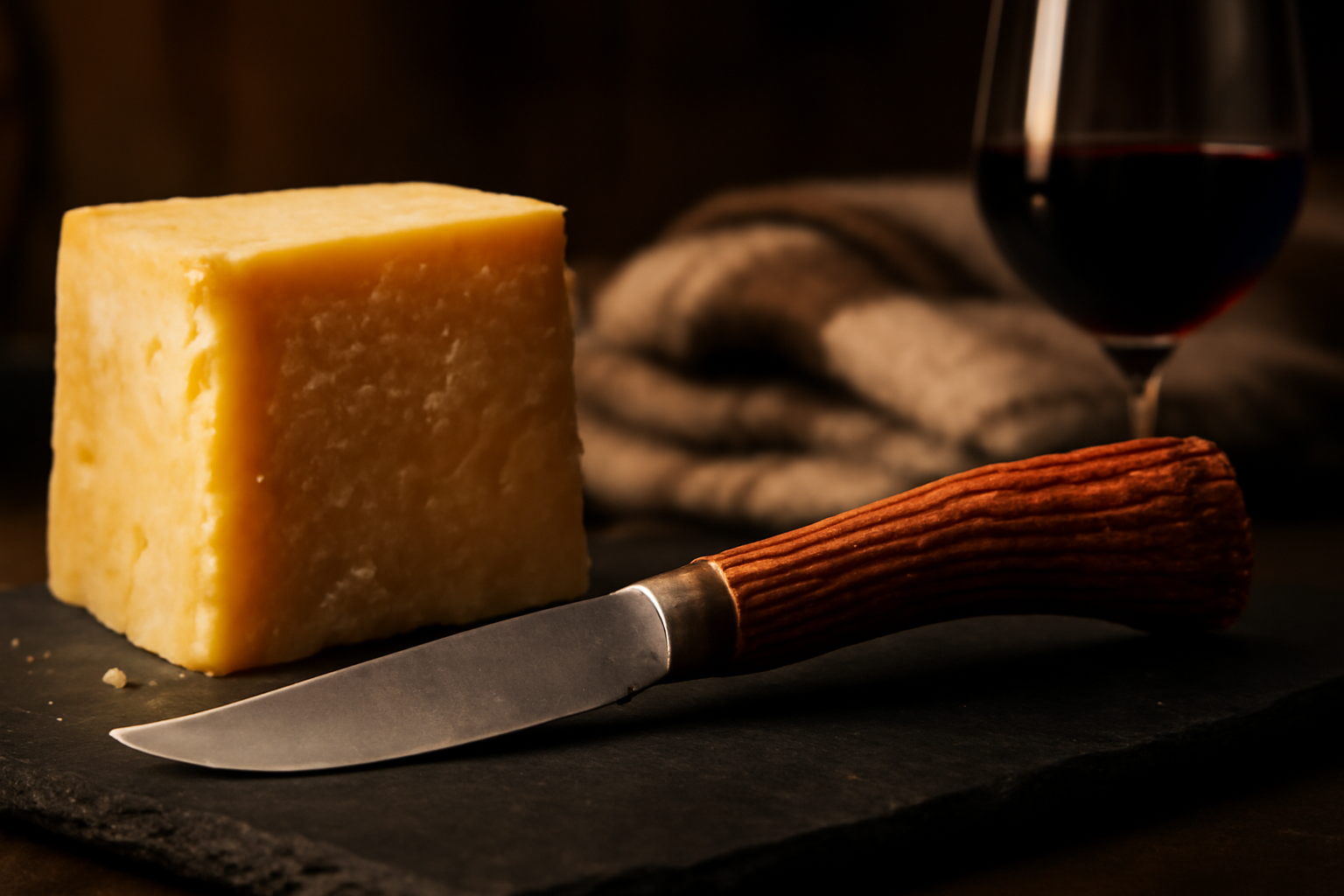
There are few culinary pleasures as profound as a truly great aged cheddar, its flavour complex and its texture a landscape of crystalline delight. But to unlock its full potential is an art form, one that begins long before the first bite. It is an act of consideration for the cheese, the guest, and the occasion.
The Character of Crystalline Cheddar
A vintage cheddar, aged for two, five, or even ten years, is a world away from its mild, pliable counterpart. Over time, a slow, magical transformation occurs within the cheese. The proteins and fats break down into more complex, savoury, and nutty flavour compounds. But the most celebrated transformation is textural: the emergence of cheese crystals.
These tiny, crunchy specks are often mistaken for salt, but they are a hallmark of a well-aged cheese. They primarily come in two forms. The first, and most common in cheddar, is calcium lactate. These crystals form on the surface and within the small fissures of the cheese as it loses moisture, appearing as a delicate white dusting. They have a subtle crunch and a creamy, lactic flavour.
The second type, tyrosine crystals, form within the protein matrix of the cheese itself. These are harder, more distinct, and more granular. Finding them is a sign of a truly masterful aging process, where the amino acid tyrosine has clustered together. They deliver a concentrated, brothy flavour and a satisfyingly gritty texture that connoisseurs seek out.
This crystalline lattice is what gives aged cheddar its signature crumbly, friable structure. It is dense and firm, yet prone to shattering under the wrong kind of pressure. The goal of a host is to work with this structure, not against it, to cleave the cheese in a way that preserves the integrity of these flavour-packed crystals and the paste that surrounds them.
Temperature: The Unseen Ingredient
The most significant mistake when serving any fine cheese is serving it cold, straight from the refrigerator. A cold temperature mutes flavour and hardens texture, effectively locking away everything the cheesemaker worked for years to develop. The rich, volatile aromatic compounds that create the complex notes of hazelnut, caramel, or savoury broth in an aged cheddar are dormant when chilled. The fats are solid and waxy, coating the palate rather than melting to release their full taste profile.
To awaken the cheese, it must be allowed to come to room temperature. This process, known as tempering, allows the fats to soften and the flavour compounds to become airborne, greeting the nose before they even reach the tongue. For a dense, hard cheese like a vintage cheddar, the ideal serving temperature is between 18°C and 21°C.
Achieving this requires patience. For an average 200-gram block of cheddar, you should remove it from the refrigerator at least one to two hours before you plan to serve it. A larger half-kilo wedge might need closer to three hours. Let it rest on the board, covered lightly with its wax paper or a clean cloth to prevent it from drying out, but allow it to breathe. You will know it is ready when the cheese has lost its cold sheen and you can smell its distinct, nutty aroma from a short distance away. Be mindful not to leave it out for too long, especially in a warm New Zealand summer, as excessive heat will cause the fats to separate and the cheese to appear oily or 'sweaty'. The goal is a gentle bloom, not a meltdown.
Rethinking the Cut: Leverage, Not Force
Confronted with a hard, crystalline block of cheese, the common impulse is to apply brute force. We grab a thin-bladed knife and push downwards, only to find the cheese resisting and then suddenly shattering into an unpredictable mess of crumbs and shards. This approach destroys the very texture we seek to celebrate. The secret is not more force, but better leverage, applied with a tool designed for the task.
The Ergonomics of the Artisan Handle
Standard cheese knives often feature simple, symmetrical handles—cylindrical or rectangular—made of smooth, uniform materials. This design forces your hand into a single, predetermined grip. When you apply pressure to a dense cheese, that force is concentrated in one direction, directly opposing the cheese's structural integrity. This is what leads to shattering.
An artisan-carved, non-symmetrical handle, however, fundamentally changes this dynamic. A handle crafted from a piece of naturally shed New Zealand red deer antler, for example, is entirely unique. Its organic shape offers a multitude of curves, swells, and subtle facets. This is not a design flaw; it is its greatest functional advantage. These natural contours become custom leverage points.
Instead of a single forceful push, you can find a grip that allows for a controlled, rocking motion. By bracing a curve of the antler against your palm and placing your forefinger along a straighter section, you can change the angle of applied force. Shifting your grip by just a few millimetres engages a different part of the handle, allowing you to subtly adjust your leverage. This translates pressure from your hand, through the handle, and into the blade as a slow, deliberate cleaving force. You are not fighting the cheese; you are guiding the blade along its natural fissures. This controlled pressure cleanly separates the cheese, preserving the crystalline structures and yielding pieces with beautiful, craggy faces.
Blade Geometry and Material
The handle is only half of the equation. The blade itself must be suited to the task. For a hard cheddar, a wide, sturdy, spade-like blade is ideal. The broad surface provides the structural strength needed to withstand the pressure of cleaving a dense block without flexing or bending. A full tang—where the steel of the blade extends all the way through the handle—adds immense stability and balance, making the entire tool feel like a solid, reliable extension of your hand. High-quality stainless steel ensures a durable, sharp edge that will not corrode or impart any unwanted metallic taste to the cheese, honouring its pure flavour.
The Ritual of Serving
How you present the cheese on the board is the final step in this considered process. Avoid the temptation to cut the entire block into sterile, uniform cubes. Doing so exposes too much surface area to the air and robs your guests of the tactile experience of interacting with the cheese themselves.
A more generous and engaging approach is to present the block mostly whole. Use your specialised knife to cleave off the first few pieces, arranging them near the main block. This act serves as an invitation. It shows guests how the cheese should be portioned and provides them with a starting point, making the board feel more approachable.
Having the correct instrument on the board is not just functional; it's a statement of intent. A well-crafted Antler Cheese Knife, with its natural heft and unique grip, signals that this is a cheese to be savoured and respected. It becomes a conversation piece, a link between the wild provenance of the antler, the agricultural craft of the cheesemaker, and the refined pleasure of the moment.
Surround the cheddar with accompaniments that complement, rather than overpower, its flavour. Think crisp, neutral crackers, thin slices of apple or pear, or a simple quince paste. The focus should always remain on the cheese itself—the culmination of time, patience, and craft.
Serving a fine aged cheddar is a small but meaningful ritual. It’s an opportunity to slow down, to appreciate the nuance of a skilfully made food, and to honour the years of work sealed within the block. By paying attention to temperature, technique, and the tools you use, you transform a simple act of eating into a memorable culinary experience. We invite you to explore an instrument born from the wild heart of New Zealand, designed to honour the craft of cheesemaking.
Related reading
Lifestyle & Home· 5 min read
The Forgotten Sensory Axis: Why Product Weight Aligns with Emotional Value
We explore the forgotten sensory axis: the link between a gift's physical weight and its perceived emotional value. Learn how the heft of a handcrafted object creates a deeper memory imprint.
Read article →

Lifestyle & Home· 6 min read
The Epigenetics of Antler Growth: How a Stag’s Environment Shapes Its Form
Uncover the epigenetics of antler growth. We explore how a stag's life in the wild shapes its antlers and teach you how to spot markers of an authentic heritage.
Read article →
Lifestyle & Home· 6 min read
The Art of the Craft Beer Toast: Why the Opener Sets the Standard
Discover how the right bottle opener does more than just open your beer. It respects the craft, preserves the bottle, and elevates the entire sensory experience.
Read article →