Hosting & Entertaining· 6 min read
Real Antler vs. Resin Replicas: A Discerning Buyer’s Guide
Unsure if it's real antler? Our guide teaches discerning buyers how to spot resin fakes with simple tests for thermal retention, weight, and surface micro-pores.
By Antler Tree · 1 June 2026

The allure of antler is timeless, a direct connection to the wildness and elegance of nature. Yet, as its popularity grows, so does the proliferation of cheap imitations masquerading as the real thing. Understanding the difference is not just about value; it’s about appreciating the soul of a material shaped by a life lived in the New Zealand wilderness.
The Enduring Appeal of Natural Antler
For centuries, humans have been drawn to antler. It is one of nature’s most remarkable materials—a true bone that is shed and regrown each year, a perfect cycle of renewal. Unlike horn, which is a keratin sheath over a bone core, antler is solid bone, dense and uniquely structured. Each piece carries the story of the animal and its environment, from the food it ate to the battles it fought.
At Antler Tree, we work exclusively with naturally shed antler from New Zealand’s magnificent red deer. These antlers are foraged from the forest floor and high country stations long after the stag has parted with them. There is no harm to any animal; it is a sustainable, respectful practice of gathering a gift left behind by nature. This means every piece we craft is imbued with an ethical origin story and a distinct character. The contours, the colour variations from sun-bleaching or rubbing against trees, the sheer heft and texture—these are qualities that cannot be mass-produced. A handcrafted item made from genuine antler is more than an object; it is a piece of a landscape, a moment in an animal's life, shaped by hand into a functional work of art.
This connection to place and process is the heart of its value. When you hold a piece of real antler, you are holding a material that is strong yet lightweight, rugged yet capable of being polished to a smooth, warm lustre. It’s this profound authenticity that discerning buyers seek, and it’s what sets it worlds apart from its synthetic counterparts.
The Rise of the Resin Replica
The market for home decor and gifts is vast, and with scale comes the pressure for speed and low cost. This is the world in which resin replicas thrive. Polyresin, a durable plastic compound, can be poured into a mold to create thousands of identical items that, from a distance, mimic the shape and colour of real antler. They are easy to manufacture, inexpensive, and consistent, making them a favourite for mass-market retailers.
These replicas serve a purpose for those seeking a certain aesthetic on a tight budget. However, they are fundamentally different products. A resin replica is an image of antler; a handcrafted piece is antler. The manufacturing process is entirely industrial, lacking the touch of a craftsman who reads the unique grain and curve of each individual piece. Resin is inert, its patterns painted on, its texture artificial. While it may capture the general form, it fails to capture the essence, the history, and the unique tactile experience of the genuine article.
Problems arise when these items are marketed deceptively, using vague language or sold at prices that suggest authenticity. For the online buyer who cannot physically handle the piece before purchasing, it can be difficult to tell the difference from a photograph alone. This is where a little material knowledge becomes your most powerful tool.
A Craftsman’s Guide to Spotting a Fake
As artisans who handle real antler every single day, we can spot a replica in a moment. With a bit of guidance, you can too. Beyond the obvious red flags like suspiciously low prices or sellers with generic product catalogues, the material itself will always reveal its true nature. The key is to know what to look for and how to test it.
Obvious Visual Cues
First, examine the piece for signs of industrial manufacturing. Resin items are cast in molds, which often leave behind subtle tell-tale signs.
- Seam Lines: Look carefully along the edges of the piece for a fine, raised line. This is a mold seam, where the two halves of a mold met. While manufacturers try to sand these down, they are often still visible, especially in crevices.
- Repetitive Patterns: Real antler is perfectly imperfect. The bumps, grooves, and colouring are organic and random. A resin replica is often cast from a single master design, so if you see multiple products with the exact same pattern of bumps and ridges, you are looking at a copy.
- Unnatural Sheen: Polyresin often has a uniform, slightly waxy or overly glossy sheen that looks and feels like plastic. Real antler, even when polished, has a deeper, more variable lustre. Its surface has depth and subtle variations in colour and texture that catch the light in a more complex way.
- The Cut Cross-Section: If you can see a cross-section of the material, look at its core. Real antler has a distinct structure: a dense, bony outer wall and a porous, marrow-filled core that looks like ivory or cancellous bone. Resin is typically solid and uniform in colour and texture all the way through, or it might be hollow.
Diagnostic Tests for the Discerning Buyer
For the online shopper who has received an item and is questioning its authenticity, a few simple physical tests can provide a definitive answer. These methods rely on the fundamental differences in material composition between organic bone and synthetic polymer.
The Thermal Retention Test: This is one of the most reliable and immediate tests. Antler, being a dense, bone-like material, has significant thermal mass. When you first pick it up, it will feel cool to the touch, similar to stone. As you hold it, it will slowly and gradually warm up from the heat of your hand. In contrast, plastic or resin has very low thermal conductivity and mass. It will feel much closer to room temperature initially and will warm up almost instantly in your palm. The difference is distinct: real antler feels substantial and cool; resin feels inert and immediately adapts to your temperature.
The Weight and Balance Test: Nature does not create with uniform density. A real antler's structure is heavier and denser near the base (the burr or coronet) and becomes progressively lighter and less dense towards the tip of the tine. A craftsman making a handle or object will work with this natural imbalance. A genuine antler handle will feel organic and have a unique center of gravity. A cast resin piece, however, is typically uniform in density. It will feel unnaturally balanced, sometimes described as feeling “dead” in the hand. The weight distribution is even and predictable, lacking the lively, characterful imbalance of the real thing.
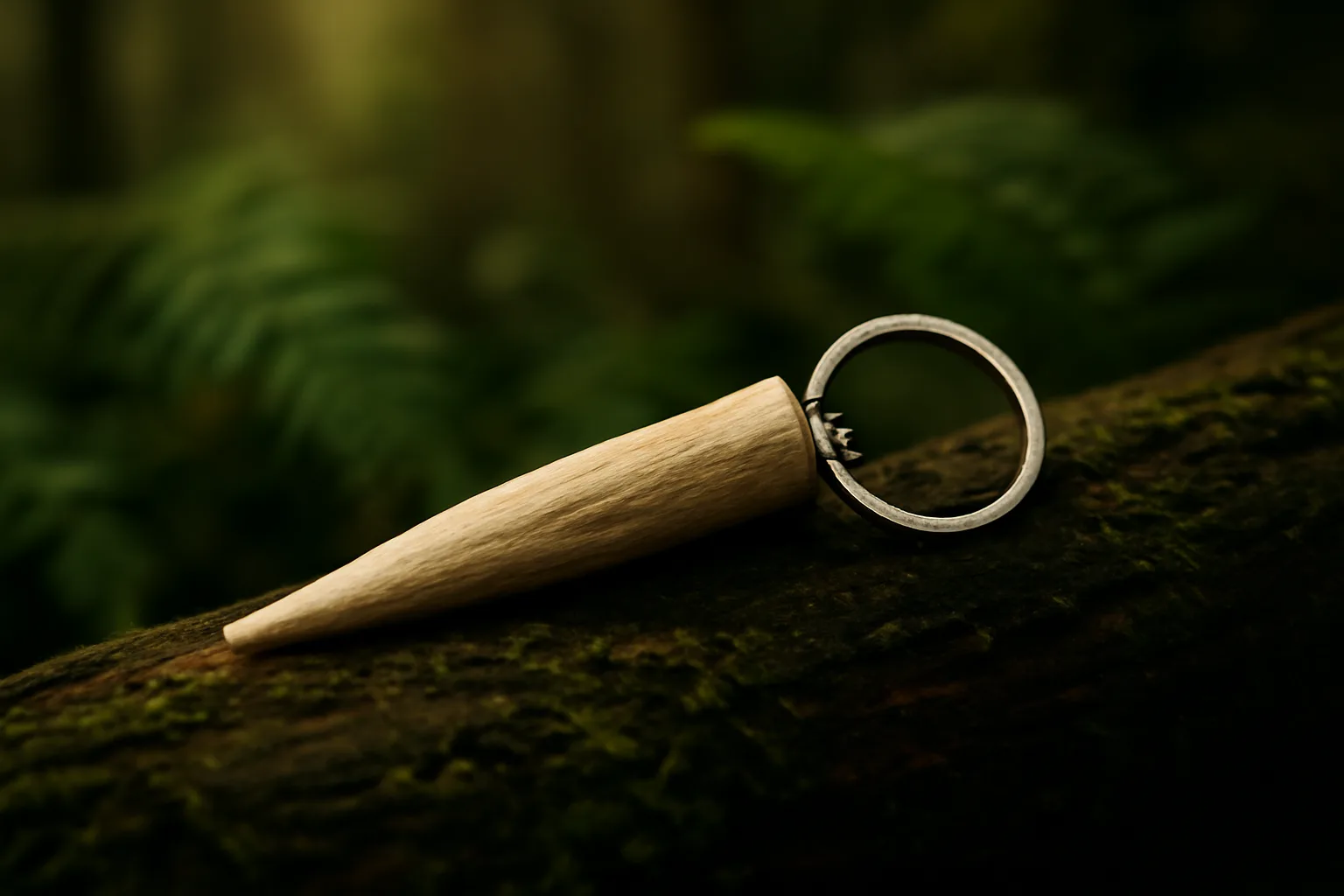
The Micro-Pore Inspection: Here is where the truth is written in fine detail. Antler is a porous, vascular material, filled with microscopic channels known as Haversian canals that once transported blood and nutrients. Even on a polished surface, these pores are present. Under close examination—perhaps with a tool like an Antler Handle Magnifying Glass—you can see these tiny, irregular pinpricks and channels. They are part of the material's grain. Resin, being a non-porous polymer, is perfectly smooth at a microscopic level. The only 'pores' you might find are perfectly spherical, trapped air bubbles from the casting process, which look very different from the organic structure of bone.
The Soul of the Material
Beyond these physical tests lies a more intuitive difference. When we select a piece of shed antler for a project, we are not simply choosing a raw material. We are reading a story told in form and texture. We study its curves, its weight, and its strength to decide its destiny. Will this robust, gnarled burr become the handle for a fire poker, or will this elegant, slender tine be shaped into the body of a pen? The antler guides the design.
This dialogue between maker and material is absent in the production of replicas. A mold dictates its form, and every resulting piece is identical. There is no uniqueness, no narrative, no connection to a wild place. A handcrafted antler object is a collaboration between a craftsman and nature itself. It carries an authenticity that resonates, an energy that a plastic imitation can never replicate. It’s a commitment to longevity, sustainability, and the enduring beauty of the natural world.
Choosing genuine antler is an investment in an object with a past and a future. It will develop a rich patina over years of use, its story becoming intertwined with your own. We invite you to look closer, to feel the difference, and to appreciate the profound character that only nature, time, and skilled hands can create.
Related reading

Hosting & Entertaining· 6 min read
The Document Archivist’s Toolkit: Reading Faded Inks and Vintage Print
Discover essential preservation methods for historical documents. Learn to decipher faded inks and vintage print with an archivist's toolkit and techniques.
Read article →

Hosting & Entertaining· 6 min read
The Craft Beer Pour: Why the Opening Ritual Influences Taste Perception
Discover how the ritual of opening a craft beer influences taste. This article explores the physics of a perfect pour and why a quality bottle opener matters.
Read article →
Hosting & Entertaining· 6 min read
Passive Harvesting: The Absolute Peak of Ethical Manufacturing
Explore passive harvesting, a zero-harm model of making. Discover how using naturally shed deer antler offers a profound ethical alternative to resource extraction.
Read article →