Craft & Materials· 6 min read
Statement Jewelry for Minimalists: Embracing Raw, Earthy Accents
A style guide for minimalists on using raw, nature-inspired jewelry to elevate a wardrobe, exploring the unique material qualities of natural elements like antler.
By Antler Tree · 1 June 2026
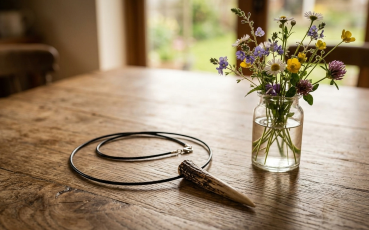
Minimalism isn’t about wearing less, but about choosing with more intention. The right piece of jewelry doesn''t just accessorise an outfit; it completes the thought. A single, powerful focal point can elevate an entire wardrobe built on quiet quality.
The Minimalist''s Dilemma: Finding Focus Without Fuss
A minimalist wardrobe is a study in form, fabric, and restraint. It is built on a foundation of impeccably tailored essentials: the perfect cashmere crewneck, the crisp linen shirt, the heavyweight cotton tee. Each piece is chosen for its enduring quality and versatility. Yet, this curated quietness can sometimes feel anonymous, lacking a definitive personal signature.
This presents a unique challenge: how does one introduce character and focus without disrupting the calm? The answer rarely lies in adding more layers or fleeting trends. Instead, it lies in the art of the singular statement. A single piece of jewelry, chosen with the same care as the foundational garments it adorns, can act as an anchor for the entire look. It provides a focal point, drawing the eye and telling a story that the quiet hum of quality basics cannot tell alone. It is the punctuation mark at the end of a well-crafted sentence.
The search is for an object that feels both significant and integrated, something that enhances rather than competes. It must possess a visual and tactile weight that gives it presence, yet feel personal and harmonious when worn.
Nature as the Ultimate Designer
When seeking pieces with inherent character and timeless appeal, we often find ourselves turning to the natural world. There is a deep, psychological comfort in organic forms and raw textures. The perfect, branching symmetry of a fern, the smooth, patient curve of a river stone, the intricate grain of weathered wood—these are patterns that resonate with a primal part of our aesthetic understanding.
In design, this is often linked to the concept of biophilia, our innate human tendency to seek connections with nature. A piece of jewelry carved from a natural material does more than just decorate; it carries a whisper of its origin. Unlike the cold, hard geometry of machine-made ornaments, a nature-inspired piece is imbued with a unique, unrepeatable history. Its subtle asymmetries and tactile variations are not flaws, but evidence of its authenticity.
This is the appeal of materials like antler, stone, wood, and shell. They possess a kind of honest beauty. They are not trying to be perfect, only true to their own form. When you wear a piece crafted from such a material, you are wearing a small fragment of a larger story—a story of growth, time, and place. It’s an antidote to the disposable and the mass-produced, a quiet rebellion in favour of the real.
Beyond the Metal: The Material Soul of Your Jewelry
Choosing a statement piece goes beyond visual appeal; it is a sensory decision. The way a necklace rests against your collarbone, its weight, its temperature, and its texture all contribute to the experience of wearing it. Here, the distinction between common mass-market jewelry and thoughtfully crafted pieces from natural materials becomes profoundly clear.
The Cold Reality of Fast-Fashion Alloys
Much of the accessible, trend-driven jewelry available today is constructed from a narrow range of industrial metals. Typically, a core of brass (a copper-zinc alloy), zinc, or a pewter-like mixture is plated with a microscopically thin layer of gold or silver. While this provides an initial shine, the experience of wearing these pieces is often disappointing.
These alloys are dense. A large pendant made of plated brass can feel surprisingly heavy, pulling uncomfortably throughout the day. More importantly, metal is a highly effective thermal conductor. When you first put it on, it feels cold against your skin because it is rapidly drawing heat away from your body. This sensation of a cold, foreign object often persists. Furthermore, as the thin plating inevitably wears away from friction and contact with skin oils, the base metal is exposed. These core alloys often contain nickel, a notorious contact allergen that affects an estimated 10-20% of the population, causing redness, itching, and irritation. Even without a true allergy, the chemical reaction between acidic skin oils and base metals can lead to discolouration—both of the piece and your skin.
The Warmth and Honesty of Natural Elements
In stark contrast, consider a material like naturally shed deer antler. As a biological material, its properties are fundamentally different from those of metal. Antler is bone, a natural composite primarily made of a calcium phosphate matrix woven with collagen fibres. This structure gives it incredible strength for its weight.
Antler is significantly less dense than metal. The specific gravity of antler is around 1.7 g/cm³, whereas brass is about 8.5 g/cm³. This means a piece of antler of the same size as a brass equivalent will weigh 80% less. It feels almost weightless, becoming an effortless part of your attire rather than a cumbersome addition.
Crucially, antler is bio-inert. It contains none of the reactive metals like nickel, copper, or cadmium that cause skin sensitivity. It is hypoallergenic by its very nature. But perhaps the most profound difference is thermal and tactile. Unlike metal, antler is a poor thermal conductor. It does not aggressively pull heat from your skin. Within moments of contact, it warms to your body''s temperature. This small but significant detail transforms the experience of wearing it. The piece no longer feels like a foreign object; it feels like an integrated part of you. The subtle, porous texture is warm and organic, a constant, comforting presence against the skin.
Styling the Statement: How to Wear a Natural Accent
A piece with such inherent character does not require elaborate support. Its purpose is to stand out against a simple, considered backdrop. The beauty of a nature-inspired statement necklace lies in its versatility and its ability to transform the most fundamental garments.
Consider pairing it with the high, soft neckline of a black or charcoal merino wool turtleneck. The dark, uniform background allows the pale, organic form of the antler to become a striking focal point, a slash of light and texture against the dark canvas. The contrast between the soft-spun wool and the smooth, hard bone is a masterclass in textural play.
For a more relaxed but equally sophisticated look, let the necklace rest in the open V of a crisp, unbuttoned shirt, crafted from white cotton or natural linen. The frame created by the collar draws the eye directly to the piece, while the smooth plane of the fabric highlights its unique shape. It’s an effortless gesture that speaks of a relaxed, confident style.
Even the most basic of wardrobe staples—a high-quality crewneck t-shirt and well-fitting denim—can be elevated. A piece such as a handcrafted Antler Necklace turns this simple uniform into a deliberate statement. The key is to maintain balance. When wearing a necklace of this nature, keep other jewelry to a minimum. Avoid competing earrings or bracelets. Let the one piece speak, and give it the space to be heard.
A Story of Place and Purpose
Ultimately, the most compelling objects are those with a story. A handcrafted antler necklace from our New Zealand workshop is more than an accessory; it is a direct link to a time and a place. It begins its journey in the remote, tussock-covered high country, where red deer shed their antlers each spring in a natural, cyclical process.
This material, freely and ethically given by nature, is then collected and brought back to our workshop. Each piece of antler is unique, shaped by the life of the animal and the landscape it roamed. Our role as craftspeople is not to impose a form upon it, but to discover the one that already exists within. We carefully select, cut, and polish each fragment, working to reveal the beauty of its internal structure and honour the graceful curve of its original form.
This mindful process ensures that no two pieces are ever identical. The one you choose carries with it the story of the New Zealand wilderness and the touch of the artisan''s hand. It is a commitment to craft over mass production, and to a renewable resource over extractive industries.
A piece of jewelry can be a token of a trend, or it can be a tangible connection to the things you value. By choosing a statement piece rooted in nature and craft, you are choosing something with soul and story. It is an investment in a quiet, enduring form of beauty that feels as good as it looks, a small piece of the wild world to carry with you.
Related reading
Craft & Materials· 6 min read
Patio Hosting Mechanics: Selecting Slip-Resistant Tools for Summer Barbecues
A guide to high-durability, slip-resistant barbecue tools. We analyze why natural antler grips better than polymer in wet conditions for confident patio hosting.
Read article →
Craft & Materials· 6 min read
Replacing Greenwashed Corporate Swag with Genuinely Sustainable Luxury
Tired of disposable corporate swag? Discover how naturally shed deer antler offers a truly sustainable, carbon-neutral luxury gift that lasts a lifetime.
Read article →
Craft & Materials· 6 min read
The Psychology of Hosting: How Weighty Bar Tools Change the Guest Experience
Discover the psychology of hosting. We break down the weight-value heuristic, revealing how the heft of quality bar tools subconsciously signals value to your guests.
Read article →