Hosting & Entertaining· 6 min read
The Ergonomics of Cutting: Minimizing Wrist Strain on the Cheese Board
Struggling with hard cheeses? We break down the ergonomics of cutting, revealing how a hand-conforming grip minimises wrist strain and improves leverage on the board.
By Antler Tree · 1 June 2026
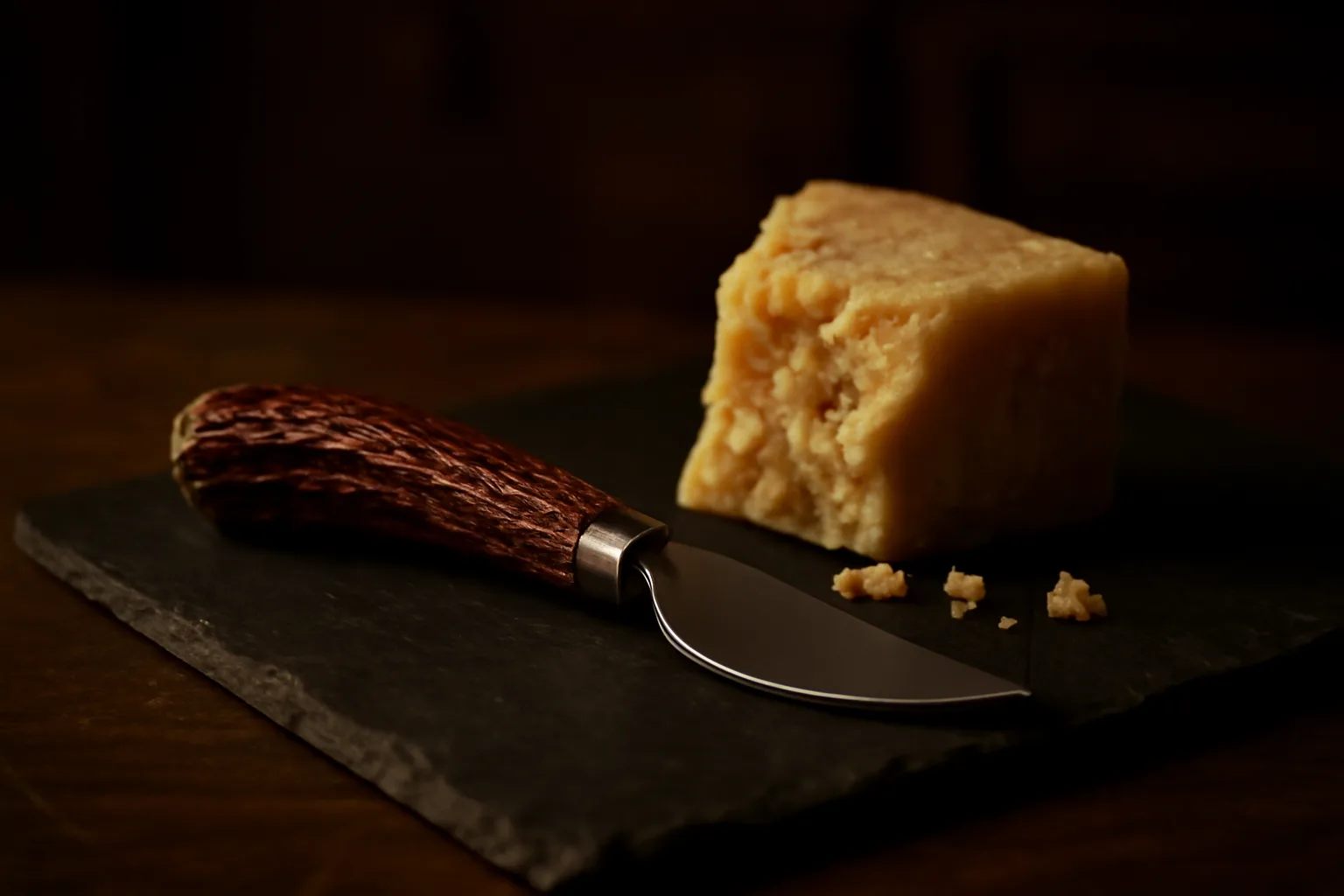
There is a quiet tension that settles over an otherwise perfect cheese board, a moment of hesitation before the first cut into a hard, aged cheese. This small struggle is not a measure of strength, but a failure of design. It speaks to a fundamental misunderstanding between the tool in our hand and the task before us.
The Hesitation on the Platter
You have composed a beautiful platter. Beside the creamy brie and soft chèvre sits the main event: a formidable wedge of aged cheddar, a block of nutty Gruyère, or the crystalline king, Parmigiano-Reggiano. A guest picks up the provided knife, positions it, and presses. Nothing happens. They reposition, apply more force, their knuckles whiten, and their wrist bends at an awkward angle. A few jagged crumbs might break free, or the knife might slip, marring the presentation. More often than not, they give up, moving on to the softer, easier options.
This is a familiar scene, and it stems from a simple ergonomic conflict. Standard cheese knives, with their often thin, straight, or overly decorative handles, force the human hand into a position of mechanical disadvantage. The act of cutting becomes a contest of brute force against a dense material, a contest the wrist is not built to win. This leads to strain, discomfort, and a shared reluctance to engage with what should be the highlight of the board. The problem isn't the cheese; it's the physics of the cut.
Force, Form, and Fulcrums
To understand the solution, we must first appreciate the problem in mechanical terms. Cutting is an act of applying pressure — defined as force divided by area. A sharp blade minimizes the 'area' component, but the 'force' is entirely up to the user. How that force is generated and transferred through the tool is what separates an effective cut from a frustrating struggle.
When you grip a typical knife with a straight, narrow handle to cut something hard, your hand and wrist are forced to perform multiple functions simultaneously. You must grip tightly to prevent slipping, aim the blade, and, most critically, apply significant downward force. To do this, the wrist often bends sharply (a movement known as flexion or ulnar deviation), compressing the delicate nerves and tendons running through the carpal tunnel. In this bent position, the wrist is at its weakest. You are pushing against the cheese while your own anatomy is pushing back against you.
Think of your arm as a lever. For an efficient cut, the force should travel in a straight line from your shoulder, through your elbow, and down through your wrist into the blade. A poorly designed handle disrupts this kinetic chain, creating a weak link at the wrist. The force dissipates into strain rather than being channelled effectively into the cut.
The Anatomy of an Ergonomic Grip
True ergonomic design is not about softness or padding; it is about form that complements function. It works with the body’s natural mechanics, not against them. This is where the unique, organic structure of a material like naturally shed antler provides a remarkable advantage, offering a hand-conforming, multi-angled grip that transforms the cutting process.
The Flaw in the Single-Axis Handle
A standard cylindrical or flat-sided knife handle offers a single, primary grip axis. Your hand can clench around it, but there are few features to lock your grip in place or to distribute pressure. When you push down hard, the force is concentrated on a few small points: where your fingers wrap and where the base of the handle presses into your palm. This concentration of force is inefficient and leads directly to muscle fatigue and joint strain. To compensate, a user might shift their grip, perhaps placing their index finger along the spine of the blade, but this only offers marginal improvement and can reduce stability.
The Antler Advantage: A Multi-Angled Architecture
A handle crafted from the base of a naturally shed deer antler is fundamentally different. It is not uniform; it is a complex, three-dimensional form shaped by nature. This organic architecture provides multiple surfaces and angles that work in concert to support the hand.
Consider the mechanics: a well-chosen piece of antler offers a natural palm swell. This curve fits into the hollow of your hand, dramatically increasing the surface area of contact. Instead of pressure being focused on a narrow line, it is distributed broadly across the entire palm. This simple change can reduce the peak pressure on any single point by over 50%. The force required for the cut remains the same, but the perceived effort and strain on the user’s hand are significantly lessened.
Furthermore, the textured 'coronet' or 'burr' at the base of the antler acts as a natural hilt or stop. As you push forward and down, the heel of your hand braces against this solid, wide flare. This creates a secure fulcrum, preventing the hand from sliding forward onto the blade and allowing you to transfer power directly from your forearm, bypassing the weaker wrist joint. This means more of your body weight is channelled efficiently into the cut. Applying 15kg of force through a slim, featureless handle might focus 70% of that load directly onto the wrist joint. The same force applied through a contoured antler handle might see that wrist load drop to 30%, with the remainder being safely absorbed by the larger muscle groups of the arm and the structural lock provided by the handle's shape.
Technique Meets Tool
An exceptional tool does more than just perform a task; it teaches you how to perform it better. The right knife encourages and rewards good technique. When you hold a tool with proper balance and an ergonomic grip, you naturally fall into a more effective posture.
Instead of standing to the side and pushing awkwardly, you will find yourself standing more directly over the cutting board. This allows you to bring your body weight into play, generating force from your core and shoulder. The cut becomes less of a push and more of a controlled lean. The weight and balance of a well-crafted tool like the Antler Cheese Knife naturally encourages this posture, guiding the user to apply pressure from a place of strength. For hard rinds, the curved blade of such a knife allows for a gentle rocking motion, concentrating the force along a small, moving point to split the rind with precision rather than brute force. For the softer interior, a steady downward press is all that is required. The tool adapts to the task, and you adapt with it.
The Enduring Nature of Antler
Beyond the superior ergonomics, there is a substantial and tactile quality to a handle made from naturally shed New Zealand red deer antler. Each piece is unique, a record of a year in a stag's life, shed naturally in the wild. It carries a density and a warmth that synthetic materials cannot replicate. It feels solid and permanent in the hand.
This is not a disposable gadget but an enduring piece of functional art, handcrafted in our workshop to last for generations. The material itself is incredibly tough and resilient, built to withstand the clashes of stags. In the context of the kitchen, this translates to a tool that will not crack, warp, or degrade. It connects the user not only to the food they are preparing but also to the wild, beautiful landscapes of New Zealand from which the material came. It is a story of nature, craft, and thoughtful design you can hold in your hand.
Ultimately, serving a fine cheese should be an act of generosity and pleasure, not a test of wrist strength. The right instrument transforms the experience, making the difficult effortless and allowing the quality of the food to take centre stage. It is a small detail that makes a profound difference, turning a moment of hesitation into an invitation to enjoy.
Related reading
Hosting & Entertaining· 6 min read
The Document Archivist’s Toolkit: Reading Faded Inks and Vintage Print
Discover essential preservation methods for historical documents. Learn to decipher faded inks and vintage print with an archivist's toolkit and techniques.
Read article →
Hosting & Entertaining· 6 min read
The Craft Beer Pour: Why the Opening Ritual Influences Taste Perception
Discover how the ritual of opening a craft beer influences taste. This article explores the physics of a perfect pour and why a quality bottle opener matters.
Read article →
Hosting & Entertaining· 6 min read
Passive Harvesting: The Absolute Peak of Ethical Manufacturing
Explore passive harvesting, a zero-harm model of making. Discover how using naturally shed deer antler offers a profound ethical alternative to resource extraction.
Read article →