
Hosting & Entertaining· 6 min read
The Gelato Connoisseur’s Toolkit: Temperature Control and Portioning
A guide to serving perfect artisan gelato. Learn the secrets of temperature control and the physics of why a solid-core scoop outperforms all others.
By Antler Tree · 1 June 2026
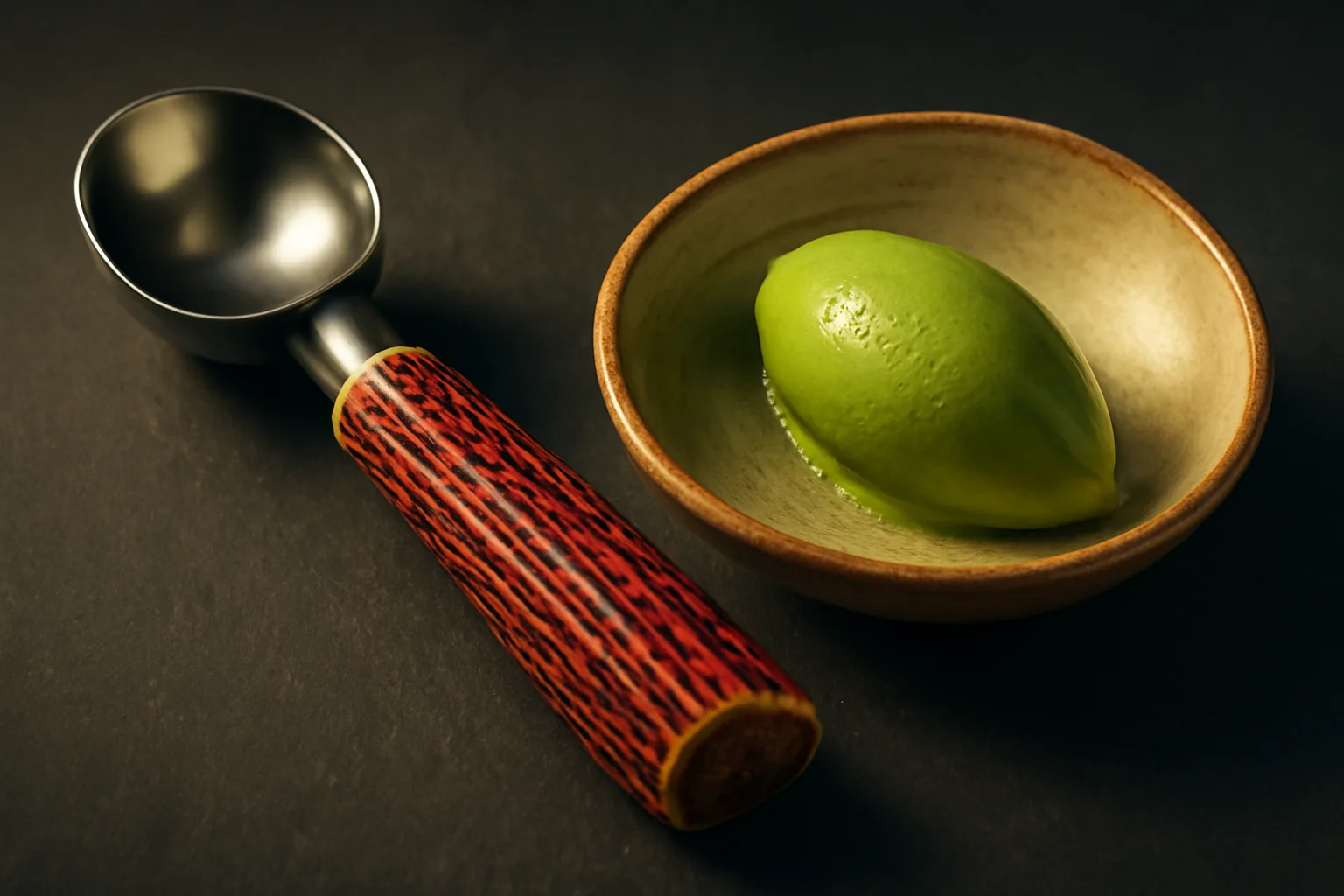
Serving a truly great artisan gelato is an act of preservation. You are the final guardian of the maker’s craft, and the last few feet from the freezer to the bowl are where its character can be either honoured or diminished. The difference lies not in grand gestures, but in the quiet details of temperature and the quality of the tool in your hand.
The Art of Tempering: Why Temperature Matters
Artisan gelato and sorbet are fundamentally different from commercial ice cream. They are churned at a slower speed, incorporating less air, which results in a denser, silkier texture. They also contain less butterfat and are typically served at a warmer temperature, from -14°C to -12°C, compared to the -18°C or colder at which ice cream is stored and served.
This narrow temperature window is crucial. It’s where the flavours are most vibrant and the texture is at its peak plasticity—soft enough to yield to a scoop, yet firm enough to hold its shape. When you bring a pint home from a gelateria or a market, it’s almost certainly frozen to a much harder, travel-safe temperature. Scooping it straight from the freezer is a common mistake that leads to three problems:
- Flavour Muting: Extreme cold numbs the taste buds, masking the complex notes the maker so carefully developed.
- Structural Damage: Attacking a rock-solid block of gelato with force shatters its delicate crystalline structure, resulting in a crumbly, icy texture rather than a smooth, elastic one.
- Tool Failure: It’s the fastest way to bend a flimsy spoon or break a poorly made scoop.
The solution is a process called tempering. This simply means allowing the gelato to soften slightly before serving. The most reliable method is to move the container from your freezer to the main compartment of your refrigerator for 20-30 minutes. You’re looking for the edges to have just begun to soften, while the core remains firmly frozen. This temperature gradient makes scooping dramatically easier and ensures the final product in the bowl is at the perfect consistency for immediate enjoyment.
The Problem with the Common Scoop
Most of us have a generic ice cream scoop rattling around in a drawer. It’s often a thin, stamped-metal tool, sometimes with a “comfort grip” plastic handle or a mechanical release trigger. While functional for softer ice creams, these designs present significant issues when faced with dense, hard-frozen desserts.
Many of these scoops are constructed from multiple pieces. The head is formed separately from the handle, and the two are joined by a weld, a rivet, or simply inserted and glued. This join creates an inherent point of weakness. The force you exert is concentrated at this single point, and under the strain of cutting through a hard-frozen pint, the metal can bend or the handle can detach completely. Trigger mechanisms, with their springs and levers, add more failure points and create crevices that are difficult to clean, trapping old ice cream and ice crystals that can compromise the texture of your next scoop.
A popular workaround is the hot water trick—dipping the scoop in hot water to help it cut through the frozen mass. This is a crutch, not a solution. It works by melting the gelato on contact, which introduces water crystals and creates a soupy layer on the surface of your otherwise perfect sphere. It damages the very texture you’ve been trying to preserve through careful tempering.
Force, Form, and Failure: The Physics of Scooping
A superior tool is not just about better materials; it’s about smarter design informed by an understanding of physics. The challenge of scooping hard gelato is a question of transferring force efficiently and withstanding the immense pressure exerted on a small surface area. This is where the concept of a unified, solid-core construction reveals its true advantage.
The Weakness of Welded Joints
Imagine a standard metal scoop made from a cast head and a separate metal tube for a handle. The point where they are welded together is a stress riser. When you push the scoop into hard gelato, the resistance doesn't just push back—it exerts torsional (twisting) and shear (slicing) forces. In a multi-piece tool, these forces are focused directly on the weld or join. The molecular bond of a weld, while strong, is often more brittle than the parent metal surrounding it. Repeated stress cycles of pushing and twisting will eventually lead to micro-fractures and, ultimately, failure. The scoop head bends backward, or the handle snaps off. It’s a predictable outcome of a design that fights against physics rather than working with it.
Density Dynamics and Structural Integrity
Now, consider a tool built with a different philosophy: a solid stainless steel shank that extends deep into a dense, solid handle. Here, there is no single weak point. The force you apply with your hand is transferred seamlessly down the length of the tool, through the handle, along the shank, and to the sharpened edge of the scoop head.
The handle itself becomes a critical part of the structural system. This is where a material like naturally shed New Zealand red deer antler truly excels. Antler is not just a beautiful natural material; it is a biomechanical marvel. It has a composite structure, with a dense, cortical outer layer and a tougher, trabecular (honeycomb-like) core. This internal matrix is incredibly effective at dissipating stress. Instead of concentrating force at one point, it distributes it throughout its entire structure.
When you push a tool like the Antler Ice Cream Scoop against a block of sorbet, the force travels from your palm, through the solid antler, and into the steel. The antler's density and integral structure prevent any flex or torsion at the junction, meaning 100% of the energy is directed to the scoop's cutting edge. The tool feels like a direct extension of your arm. Furthermore, antler is a natural insulator. It doesn't conduct cold back into your hand like a metal handle, nor does it rapidly transfer heat from a hot water dip to the scoop head, offering thermal stability that protects both the user and the gelato.
Choosing Your Instrument: Material and Craftsmanship
When selecting a tool for a connoisseur’s kitchen, you should look for the same qualities you admire in the food you serve: integrity, quality materials, and thoughtful design. An exceptional gelato scoop is defined by a few key characteristics:
- A Solid Core: Seek out a design where the metal of the scoop head extends as a solid shank deep into the handle. This is the most important feature for longevity and performance.
- A Quality Head: The business end should be made of high-grade stainless steel. A sharpened or spade-like edge is superior for cutting cleanly through frozen desserts rather than compressing them.
- A Balanced, Ergonomic Handle: The handle should have enough mass to provide leverage and feel balanced in the hand. Natural materials like antler or wood offer a warm, secure grip that metal or plastic cannot replicate. Each piece of naturally shed antler is unique, with its own grain and texture, making the tool a personal object of functional art.
Investing in a handcrafted tool connects you to a lineage of craftsmanship. It transforms a mundane task into a satisfying ritual. It’s an acknowledgment that the way we do things, and the tools we choose to do them with, matters.
Beyond the Scoop: Presentation and Ritual
Once you’ve successfully portioned your gelato, the final step is presentation. Serving it in a chilled bowl helps maintain its tempered state for longer. A simple ceramic or glass bowl, placed in the freezer for ten minutes before serving, makes a significant difference.
You can aim for the classic spherical scoop or practice forming a quenelle, the elegant oval shape favored in high-end restaurants. This is achieved by dragging the scoop across the surface of the gelato at a low angle, allowing it to curl back on itself. A great scoop makes this process fluid and achievable.
Ultimately, serving gelato is about more than just dessert. It is an opportunity to slow down, to appreciate the sensory details, and to share something beautiful with others. It is an act of hosting, where providing a moment of simple, perfect pleasure is the entire goal. The right knowledge and the right tools make that goal an effortless reality.
By understanding the interplay of temperature, texture, and force, you can elevate the simple act of serving gelato into a true connoisseur's art. We invite you to explore the difference a thoughtfully crafted tool can make in your own kitchen.
Related reading

Hosting & Entertaining· 6 min read
The Document Archivist’s Toolkit: Reading Faded Inks and Vintage Print
Discover essential preservation methods for historical documents. Learn to decipher faded inks and vintage print with an archivist's toolkit and techniques.
Read article →

Hosting & Entertaining· 6 min read
The Craft Beer Pour: Why the Opening Ritual Influences Taste Perception
Discover how the ritual of opening a craft beer influences taste. This article explores the physics of a perfect pour and why a quality bottle opener matters.
Read article →

Hosting & Entertaining· 6 min read
Passive Harvesting: The Absolute Peak of Ethical Manufacturing
Explore passive harvesting, a zero-harm model of making. Discover how using naturally shed deer antler offers a profound ethical alternative to resource extraction.
Read article →