Craft & Materials· 6 min read
The 'Hard-To-Buy-For' Man: A Strategic Gift-Sourcing Framework
Learn how to find the perfect gift for the man who has everything. Our guide introduces the Story-to-Utility Ratio for sourcing meaningful, functional objects.
By Antler Tree · 1 June 2026
Gifting for the individual who buys whatever they want is not a problem of generosity; it is a problem of sourcing. The solution lies not in finding more, but in discovering objects with a depth and character that cannot be acquired with a simple click. It requires a shift in strategy from acquisition to curation.
The Self-Sufficient Recipient: A Problem of Value
We all know this person. Their needs are met, their wants immediately fulfilled. When a new gadget is released, they have it. When their favourite jacket wears out, a replacement is already on its way. Gifting them a standard, mass-market item feels hollow, like adding a cup of water to a flowing river. It’s a gesture that, however well-intentioned, fails to make an impact.
The challenge is not that they are ungrateful, but that their personal ecosystem is already optimised for efficiency and function. They don''t need another thing; the space in their life is reserved for objects that perform exceptionally well or hold significant personal meaning. Trying to compete on the level of pure utility is often a losing battle—they have already researched and purchased the best tool for their perceived job.
This is where the conventional gift-giving approach collapses. The solution is not to guess at a niche need they may have overlooked, but to reframe the entire concept of what a gift can be. We must move beyond mere function and introduce a different, more resonant form of value: story.
Introducing the Story-to-Utility Ratio
To find a truly exceptional gift for this person, we need a new framework. Forget browsing endless ''Top 10'' lists. Instead, evaluate potential gifts using the Story-to-Utility Ratio, a mental model that balances an object’s everyday usefulness with its narrative depth. A superior gift doesn''t just do something; it means something.
The ratio is simple: How profound is its story, and how practical is its use? The goal is to find items that score high on both.
Deconstructing the Ratio
Utility (The Foundation): This is the easy part. Does it serve a purpose? And more importantly, how frequently will that purpose arise? A gift that can be integrated into a daily or weekly ritual holds far more value than a novelty item used once and forgotten. High utility doesn''t require complexity. It can be as simple as opening a bottle, making a morning coffee, or hanging a coat. The key is consistent, reliable function.
Story (The Essence): This is where a gift transforms from a commodity into an artifact. The ''story'' is not a marketing slogan; it''s a composite of three core elements:
- Raw Provenance: Where do the materials come from? ''Plastic'' is an answer, but a poor one. ''Naturally shed red deer antler from the remote high country of New Zealand’s South Island'' is an answer with texture, geography, and a connection to the wild. The material itself has a past, a cycle of life it was once part of. This authenticity cannot be faked.
- Process and Craft: How was it made, and by whom? An object that passes through human hands carries an imprint of its maker. Small-batch production, traditional techniques, and visible marks of craftsmanship distinguish an item from its sterile, mass-produced counterparts. It speaks of time, skill, and a dedication to quality that transcends pure efficiency.
- Purposeful Design: Why does it look and feel the way it does? Great design is intentional. It considers ergonomics, aesthetics, and longevity. It’s the decision to follow the unique curve of a piece of antler rather than forcing it into a uniform shape. It’s the choice of a material that will patina and improve with age, rather than degrade.
A gift with a high Story-to-Utility Ratio is one that delivers on both fronts. It performs a function flawlessly while simultaneously telling a rich, implicit story every time it''s used.
Moving Beyond the Digital Wishlist
This framework requires a deliberate shift in how we search for gifts. It means turning away from the infinite scroll of mega-retailers and seeking out the small workshops, the independent artisans, and the makers who are deeply connected to their materials.
Look for specificity. The best stories are detailed. Don''t just look for a ''wooden bowl''; look for a bowl turned from a single piece of salvaged native Rimu by a craftsman in a specific region. The details are what give the object its soul and provide the narrative you can share when you give it.
Prioritise materials that have their own voice. Antler, with its unique textures and density, feels unlike any synthetic material. The same is true for hand-forged steel, full-grain leather, or loom-woven wool. These materials carry the narrative of their origin and transformation. They engage the senses of touch and sight in a way that injection-moulded plastic never can. This tactile quality is a powerful and enduring source of value.
Applying the Framework: From Abstract to Object
Let’s make this concrete. Consider the simple, near-universal ritual of sharing a drink with friends. The act of opening a bottle is a small moment, but it''s one that can be elevated.
One option is a cheap, promotional opener. Its utility is present but minimal. Its story is non-existent. It was likely mass-produced in an anonymous factory and exists as a piece of functional detritus. The Ratio score here is exceptionally low.
Another option is a complex, over-engineered gadget. It may have high utility, but its story is one of industrial design, not human craft. It lacks warmth and character.
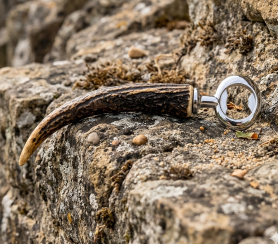
Now, consider an alternative grounded in our framework. Imagine an object designed for this exact moment, but with a story that stretches back into the wild. A hand-carved bottle opener made from New Zealand red deer antler is a perfect example of a high-scoring gift. The utility is irrefutable and frequent. The story is immense: the red deer wandering the alps, the natural cycle of shedding antlers, the forager who finds them, and the craftsman who sees the potential within the raw material. Each piece is entirely unique, its shape dictated by the life of the animal. It’s a tool that feels good in the hand, solid and connected to the natural world. It doesn''t just open a bottle; it brings a piece of the New Zealand wilderness to a shared, convivial moment.
This is the principle in action. By focusing on the intersection of a powerful story and practical, daily use, you give something that can''t be easily replaced or surpassed. You give an experience, a conversation starter, and a small, beautiful moment in an ordinary day.
This approach transforms the frustrating task of buying for the ''hard-to-buy-for'' man into a rewarding hunt for an object with integrity. It’s about finding the things they wouldn''t think to look for themselves, not because they don''t need them, but because they didn’t know an object of such character and purpose could exist. You are not just giving a gift; you are introducing them to a new, more meaningful class of object.
Related reading
Craft & Materials· 6 min read
Patio Hosting Mechanics: Selecting Slip-Resistant Tools for Summer Barbecues
A guide to high-durability, slip-resistant barbecue tools. We analyze why natural antler grips better than polymer in wet conditions for confident patio hosting.
Read article →

Craft & Materials· 6 min read
Replacing Greenwashed Corporate Swag with Genuinely Sustainable Luxury
Tired of disposable corporate swag? Discover how naturally shed deer antler offers a truly sustainable, carbon-neutral luxury gift that lasts a lifetime.
Read article →
Craft & Materials· 6 min read
The Psychology of Hosting: How Weighty Bar Tools Change the Guest Experience
Discover the psychology of hosting. We break down the weight-value heuristic, revealing how the heft of quality bar tools subconsciously signals value to your guests.
Read article →