Hosting & Entertaining· 6 min read
The Heirloom Criteria: What Makes a Gift Survive for Generations?
What transforms a simple gift into a family heirloom? We explore the criteria for longevity, from material science to timeless design, and why some objects get better with age.
By Antler Tree · 1 June 2026
We live in an age of transient objects, yet we still yearn for permanence. The things we choose to gift, to keep, and to celebrate with should carry a weight beyond their function, embodying a story that outlasts their owner. An heirloom is not simply an old object; it is a vessel for memory, intentionally or accidentally designed to survive.
The Aura of an Enduring Object
What is it that compels us to keep a grandfather’s watch or a great-aunt’s serving dish? It is not merely sentimentality. It is a connection to a tangible piece of our own history, a story we can hold in our hands. These objects possess an aura, an accumulated presence from years of use and care. They are the silent witnesses to family feasts, quiet moments of reflection, and milestone celebrations.
An object destined for this role must first be chosen with intention. It requires a buyer to look past the ephemeral trends of the moment and identify qualities that will resonate decades from now. This is an act of foresight—a recognition that the right materials and classic design can transcend a single lifetime and become part of a lineage. The gift ceases to be a simple commodity and instead becomes a future artifact, a legacy in waiting.
Material Honesty: The Foundation of Forever
For an object to last, it must be made of honest materials. This means its substance is exactly what it appears to be: solid wood, not laminate; cast iron, not coated alloy; real leather, not bonded polyurethane. In our New Zealand workshop, we build upon this principle with naturally shed red deer antler—a material that is unapologetically itself, dense and full of character.
Honest materials are inherently durable. They possess a structural integrity that withstands the minor accidents and repeated handling of daily life. Unlike complex composites or plastics that hide their cheapness under a thin veneer, a solid material has nothing to hide. A scratch on a solid oak table is just a new mark in its history; a scratch on a veneered particleboard table reveals the sawdust and glue beneath, a mark of irreversible failure.
This integrity is crucial because heirlooms are not meant for a display case. They are meant to be used. Their purpose is to be woven into the fabric of family life, and only materials that can endure this loving, continuous use are fit for the task.
The Graceful Patina vs. Terminal Decline
Perhaps the most misunderstood aspect of longevity is how an object ages. Many modern materials are designed for day-one perfection, a glossy finish that is only ever in a state of decay. Natural materials, however, often improve with age, acquiring a patina that enhances their beauty and tells a story of their use. This distinction is rooted in material science.
The Synthetic Fade: How Modern Materials Fail
Synthetic polymers—the plastics that constitute so many of our modern goods—are not designed for graceful aging. Their long-chain molecules are vulnerable to environmental stresses that lead to irreversible degradation. Photodegradation is a primary culprit; ultraviolet radiation from sunlight excites the polymer chains, causing them to fracture. This is why ABS plastic, common in appliance casings and toys, turns yellow and brittle. The material doesn't gain character; it becomes fragile and discoloured.
Another process, hydrolysis, occurs when water molecules chemically break down polymer chains. This is common in polyesters and polycarbonates, leading to a sticky surface, loss of tensile strength, or catastrophic cracking over time. This is not a patina. It is a chemical breakdown, a terminal decline where the object loses both its aesthetic appeal and its structural function. The story it tells is one of decay, not history.
The Osteological Patina: How Antler Improves with Time
Now, consider an organic material like bone or antler. Sourced from the natural cycle of New Zealand’s red deer, antler is a remarkable natural composite, primarily composed of a dense matrix of hydroxyapatite (a calcium phosphate mineral) interwoven with collagen fibres. This structure is inherently stable and resilient.
When you hold an antler-handled object, the magic of aging begins. The warmth and natural oils from your hand are absorbed into the microscopic pores of the material. Over decades of handling—of being passed around a table, used to open celebratory bottles, and held in moments of conversation—these oils polymerize and gently fill the surface. This process, known as developing an osteological patina, does not degrade the antler. On the contrary, it enhances it.
This natural burnishing process deepens the colour, creating richer tones of cream, grey, and brown. It makes the surface smoother and warmer to the touch, giving it a subtle, semi-lustrous sheen. Unlike the failure of plastic, this patina is a physical record of human contact that integrates with the material itself, increasing its beauty without compromising its strength. The antler doesn't just age; it matures.
Designing for Generations
Beyond material, the object's form is paramount. A true heirloom must possess a timeless design that feels relevant long after the trends of its creation have passed. This means favouring classic forms, balanced proportions, and an ergonomic quality that makes it a pleasure to use.
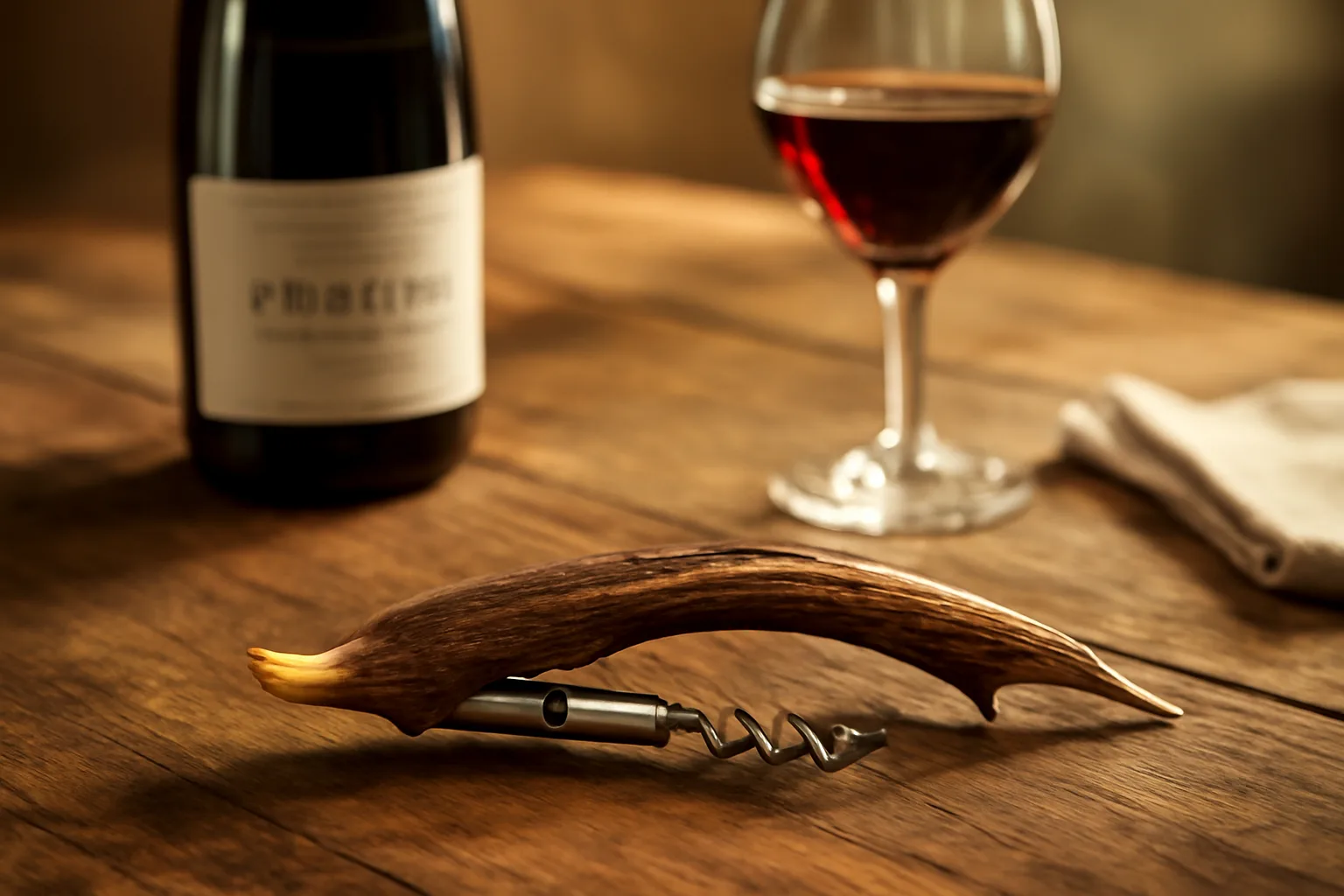
Function is key. An object that performs its task exceptionally well is an object that will continue to be used. A beautiful knife that doesn’t hold an edge will be relegated to a drawer. A handsome corkscrew that struggles with a stubborn cork will be replaced. This is why when we craft an Antler Corkscrew, we pair the unique, organic form of the handle with a high-quality, double-lever steel mechanism. The antler provides a naturally contoured, substantial grip that feels secure in the hand, while the modern mechanism ensures it works flawlessly every time. The design is a partnership between rugged nature and refined function.
Furthermore, an object designed for longevity is often serviceable. Its components might be repairable or replaceable, an anathema to the disposable logic of modern manufacturing. This signals that the item was made with the expectation of a long and useful life.
The Ritual of Continued Care
Finally, an heirloom invites a relationship. It asks for a small measure of care, transforming maintenance from a chore into a ritual. Polishing silver, oiling a wooden board, or simply wiping down an antler handle after use are small acts of custodianship. These rituals connect one generation to the next, a physical manifestation of the instruction to “look after this.”
This small investment of time reinforces the object's value. It becomes more than a possession; it's a responsibility and a privilege. The act of caring for the object is an act of caring for the family story it contains, ensuring it is in good condition to be passed on once more.
Choosing a gift with these criteria in mind—honest materials, timeless design, and a capacity to age gracefully—is an act of profound optimism. It’s a belief that the stories, traditions, and celebrations of today are worth preserving for the generations of tomorrow. When you hold an object built to last, you are holding a future memory.
Related reading
Hosting & Entertaining· 6 min read
The Document Archivist’s Toolkit: Reading Faded Inks and Vintage Print
Discover essential preservation methods for historical documents. Learn to decipher faded inks and vintage print with an archivist's toolkit and techniques.
Read article →

Hosting & Entertaining· 6 min read
The Craft Beer Pour: Why the Opening Ritual Influences Taste Perception
Discover how the ritual of opening a craft beer influences taste. This article explores the physics of a perfect pour and why a quality bottle opener matters.
Read article →
Hosting & Entertaining· 6 min read
Passive Harvesting: The Absolute Peak of Ethical Manufacturing
Explore passive harvesting, a zero-harm model of making. Discover how using naturally shed deer antler offers a profound ethical alternative to resource extraction.
Read article →