
Lifestyle & Home· 6 min read
The Kinetic Force of Scooping: Engineering a Tool That Won't Bend
Discover the physics behind bent spoons and the superior engineering of a full-tang scoop. We explore how a steel core and solid antler handle beat hard ice cream.
By Antler Tree · 1 June 2026

There is a moment of quiet, domestic tragedy that plays out in kitchens everywhere: the bent spoon. It is the silent surrender of a common utensil to the unyielding force of deeply frozen ice cream, a small testament to the failure of everyday design. This small defeat is not inevitable; it is simply a problem of physics, waiting for a better-engineered solution.
The Unseen Battle in Your Freezer
The contest begins the moment you open the freezer. Inside sits a pint of dense, artisanal sorbet or a batch of homemade ice cream, frozen to a sub-zero solidity. Standard kitchen spoons, and even many purpose-built scoops, are simply not designed for this confrontation. Their failure is a predictable outcome of their construction.
Most consumer-grade utensils prioritise mass production and low cost over structural integrity. A typical spoon or cheap scoop features a weak point where the bowl meets the handle. This junction, often a thin weld or a simple continuation of thinly stamped metal, becomes the epicentre of stress. When you exert downward and forward pressure, you are using the handle as a lever. The rim of the container acts as a fulcrum, and all the force you apply is concentrated on that vulnerable neck. The metal, lacking sufficient thickness and reinforcement, has no choice but to yield and bend.
Plastic scoops fare no better, often snapping under the immense pressure due to material brittleness at low temperatures. Even those with metal heads and plastic handles frequently fail where the two materials are joined, a connection seldom robust enough to withstand the torque required to carve through a solid block of frozen sugar and water.
A Question of Force and Fulcrums
To understand why these tools fail, we must appreciate the forces at play. Scooping hard ice cream is not a gentle act of gliding; it is a forceful act of prying. The physics involved is that of a Class 1 lever, the same principle used by a crowbar. Your hand provides the effort, the hardened ice cream provides the resistance (the load), and the edge of the scoop's bowl becomes the fulcrum.
The torque you generate—the rotational force—is immense. A utensil with a weak cross-section or a poorly designed handle joint cannot distribute this stress effectively. Instead, the force finds the path of least resistance, which is invariably the thinnest or most poorly supported part of the tool. Metal fatigue is also a factor. Each time a spoon is bent, even slightly, and then bent back, its metallic structure is weakened. Over time, it becomes progressively easier to bend, until it succumbs entirely.
This recurring failure demonstrates a fundamental disconnect between the design of most scoops and the reality of their use. They are designed for soft, pliable ice cream, not the dense, crystalline structures found in premium, low-air-content products. An effective tool must be engineered not just to hold a shape, but to actively resist the powerful deforming forces it will inevitably encounter.
Engineering Resilience: The Full Tang Advantage
To create a tool that will not bend, we must look beyond the surface and consider its internal architecture. The solution lies not in simply using more metal, but in how that metal is integrated with a handle capable of absorbing and managing extreme stress. This is where the synergy between a deep-set steel tang and a solid antler core provides a masterclass in resilient design.
Beyond the Handle: The Internal Steel Tang
In toolmaking, a 'tang' is the portion of the blade or tool head that extends into the handle. While many are familiar with the 'full tang' of a quality knife, where the steel runs the full length and width of the handle, a scoop requires a different approach. The forces are not for slicing, but for prying and levering. For this, the tang must be engineered for torsional rigidity.
Our design features a substantial, custom-forged tang made from 4mm thick, 304 food-grade stainless steel. This component is not merely glued into the tip of the handle. Instead, it extends deep—typically 70-90mm—into the core of the antler. Crucially, it is anchored mechanically. The tang is set into the antler using an industrial-grade epoxy that forms an unbreakable chemical and physical bond. This transforms the head and handle into a single, monolithic unit. The force exerted on the scoop head is not transferred to a weak joint, but is instead distributed along the entire length of this internal steel spine.
The Antler Core as a Shock Absorber
This is where the unique properties of naturally shed New Zealand red deer antler become essential. Antler is not a simple, uniform material. It is a brilliant piece of natural engineering, composed of an incredibly dense outer layer of cortical bone and a porous, lighter core of cancellous bone. This composite structure is designed by nature to withstand immense, repeated impacts during a deer's life.
When you apply force to our scoop, the rigid steel tang transmits that force into this natural shock-absorbing core. The porous, lattice-like structure of the cancellous bone works to dissipate the stress vectors in multiple directions, preventing any single point from bearing the entire load. The hard outer wall of the antler provides compressive strength, containing these forces and offering a robust, comfortable grip for your hand. The result is a system where the unyielding strength of steel and the resilient, shock-damping properties of antler work in perfect concert. The tool feels utterly solid in the hand because, from a structural standpoint, it functions as one continuous, reinforced object.
From Forest Floor to Family Table
The material itself carries a story of place and season. We exclusively use antler that has been naturally shed by New Zealand's wild red deer, a sustainable resource gathered from the forest floor and high-country stations. Each piece is one-of-a-kind, shaped by the animal's life and environment, with unique textures, colours, and contours. Our task in the workshop is to honour that individuality.
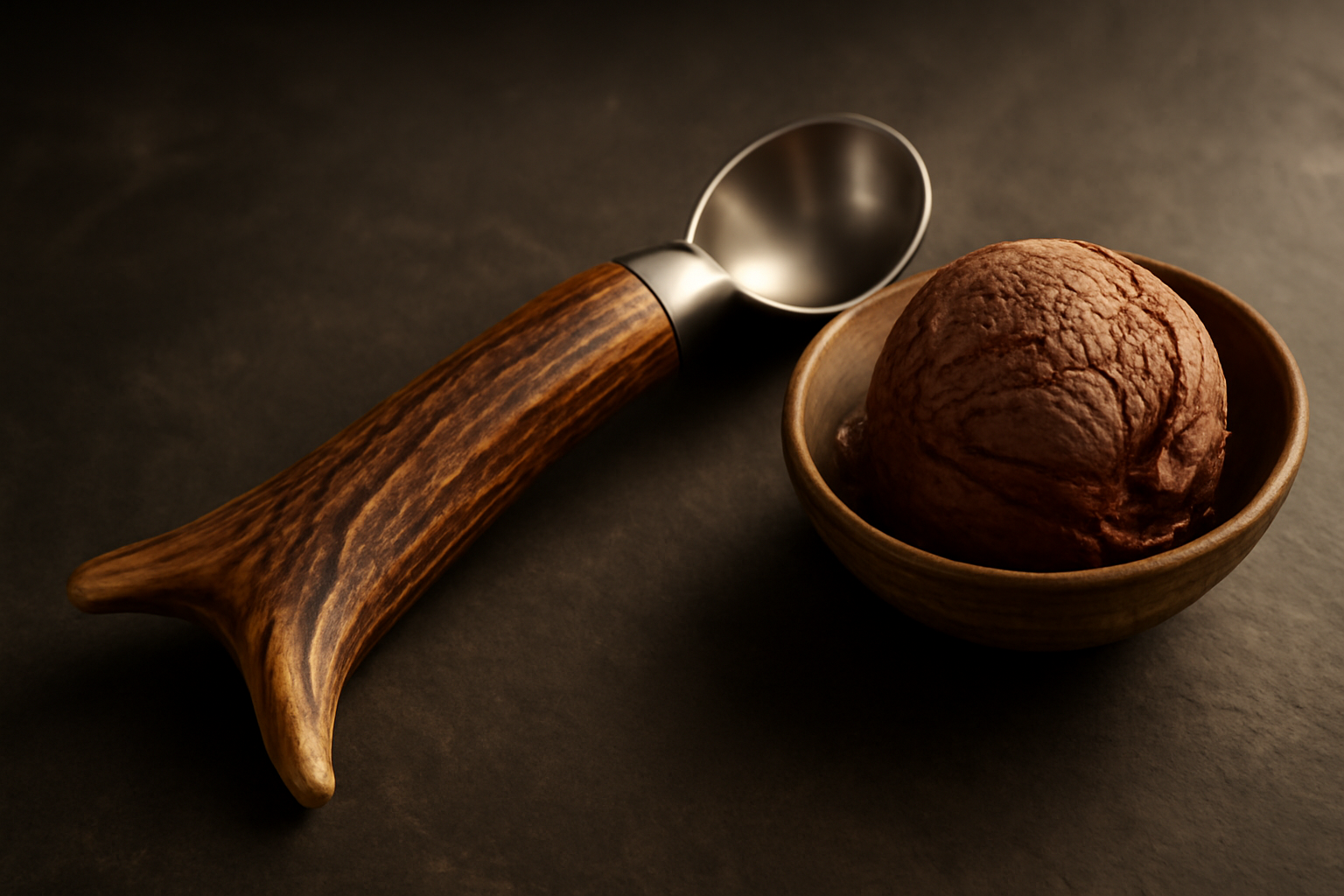
We carefully select, cut, and shape each piece of antler by hand, matching its natural form to create a comfortable, ergonomic handle. The process is one of connection—to the material, to the landscape it came from, and to the person who will eventually use it. The steel scoop head is a high-volume design with a sharpened, bevelled edge, optimised for cutting through the hardest sorbets and ice creams with minimal effort. This thoughtful engineering, combined with the organic beauty of the handle, results in a tool of surprising strength and heirloom quality, making the Antler Ice Cream Scoop a permanent fixture in your kitchen.
In a world of disposable goods, there is a deep satisfaction in owning and using an object that is built to last—a tool that performs its function flawlessly and carries a story of natural beauty and meticulous craft. It transforms a simple act like serving dessert into a moment of quiet appreciation for design that works, for materials that endure, and for the simple pleasure of sharing something good with people you care about. We invite you to experience the difference that thoughtful engineering and natural materials can make.
Related reading
Lifestyle & Home· 5 min read
The Forgotten Sensory Axis: Why Product Weight Aligns with Emotional Value
We explore the forgotten sensory axis: the link between a gift's physical weight and its perceived emotional value. Learn how the heft of a handcrafted object creates a deeper memory imprint.
Read article →
Lifestyle & Home· 6 min read
The Connoisseur's Guide to Fine Aged Cheddar: Prep, Temperature, and Tools
Learn to serve fine aged cheddar like an expert. This guide details perfect temperature, preparation, and how the right knife prevents crystalline cheese from shattering.
Read article →

Lifestyle & Home· 6 min read
The Epigenetics of Antler Growth: How a Stag’s Environment Shapes Its Form
Uncover the epigenetics of antler growth. We explore how a stag's life in the wild shapes its antlers and teach you how to spot markers of an authentic heritage.
Read article →