
Craft & Materials· 6 min read
The Physics of the Perfect Scoop: Why Mass and Balance Matter
Ever bent a spoon on frozen ice cream? We explore the physics of the perfect scoop, revealing why a scoop''s mass, balance, and solid handle matter more than muscle.
By Antler Tree · 1 June 2026
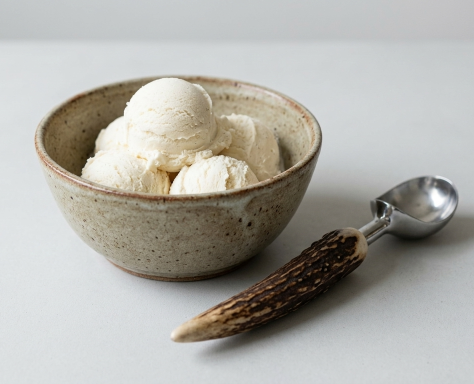
There are few simple pleasures so universally understood as a scoop of perfect ice cream. Yet, there is also the universal struggle against a deep-frozen tub, a battle that has bent countless spoons and strained many a wrist. This isn''t a failure of strength, but a misunderstanding of physics; the right tool doesn''t just overpower the ice cream, it outsmarts it.
The Struggle is Real: A Universal Kitchen Frustration
It’s a familiar scene in kitchens everywhere. The tub of premium ice cream, dense with flavour and low on air, comes out of the freezer feeling more like a block of granite than a dessert. The first attempt with a standard kitchen spoon results in a minuscule shard, the spoon handle flexing worryingly. The second, more determined attempt, ends with a bent piece of cutlery and a sore wrist.
Why is high-quality ice cream so difficult to serve? The answer lies in its composition. The best ice cream has a low "overrun," which is the measure of air incorporated during churning. Less air means more butterfat, sugar, and milk solids packed into every millilitre. When frozen to standard freezer temperatures (around -18°C), the water content crystallises into a dense, interlocking matrix. This structure is incredibly resistant to fracture. You aren''t just scooping; you are attempting to cleave a solid.
This task exposes the inherent weakness of most common kitchen utensils. A typical dessert spoon or a cheap, mass-produced scoop is designed for light duty. They are often made from thin, stamped stainless steel or, worse, cast from brittle, low-grade aluminium alloys. Their handles are hollow plastic shells or thin metal tubes. These are not tools engineered for force; they are tools designed for cost-effective manufacturing. When faced with the unyielding surface of frozen cream, they fail precisely where their design is weakest.
More Than Muscle: The Mechanics of a Scoop
To defeat the frozen block, we need to think less about brute force and more about applied mechanics. A good ice cream scoop is a specialised lever, designed to concentrate and direct force in the most efficient way possible. Understanding the principles at play transforms the act of serving from a frustrating chore into a moment of satisfying ease.
Torque and Your Wrist: A Lever in Action
At its core, an ice cream scoop functions as a Class 1 lever, much like a crowbar. Your hand provides the effort, the far edge of the scoop inside the ice cream is the load, and your wrist or the lip of the tub often acts as the fulcrum. When you push down on the handle, you are generating torque—a rotational force. The longer and more rigid the scoop, the more effectively it translates the force from your hand into a powerful cutting motion at its tip.
The problem with a flimsy scoop is that much of this energy is wasted. Instead of transferring cleanly to the scoop’s head, the force you apply is absorbed by the handle flexing and bending. It’s like trying to pry something open with a rubber bar; the energy dissipates before it can do any useful work. A rigid, unyielding handle ensures that nearly all the downward pressure from your hand and arm is converted directly into digging and curling power at the business end of the tool.
The Role of Mass and Momentum
Beyond leverage, the sheer mass of the scoop plays a crucial role. A heavier object has more inertia and, once in motion, more momentum (mass times velocity). A lightweight plastic scoop has negligible momentum. All the work must be done by your muscles in the moment.
A scoop with significant mass, however, acts as a physical aide. The weight itself helps drive the tool down into the hard surface. As you begin the scooping motion, the momentum of the heavy head helps it to continue its path through the resistant ice cream, requiring less sustained muscular effort from you. It’s the difference between trying to hammer a nail with a toy mallet versus a proper claw hammer. The mass of the tool head does a significant portion of the work for you. This is why a scoop with a solid, dense handle and a substantial stainless steel head feels so much more effective—it is physically assisting in the task.
The Critical Point of Failure: Why Flimsy Scoops Fail
The most common point of failure on an ice cream scoop is the joint between the head and the handle. This is the point where the forces of torque and pressure are most concentrated. To understand why a single-piece, solid construction is superior, we need to look at how these forces are distributed within the material itself.
Imagine a cheap scoop with a hollow plastic handle. The metal scoop head is typically inserted a short distance into the plastic and held by friction, a small pin, or adhesive. When you drive the scoop into hard ice cream and begin to lever it, you are applying immense stress to this small connection point. All the force your arm generates is channelled through a tiny cross-section of material. The stress (Force divided by Area) becomes astronomically high, far exceeding what the plastic or weak metal tang can withstand. The result is a snap, a bend, or the head pulling loose from the handle.
Now, consider a scoop made of two pieces of die-cast metal, often with a hollow handle to save on material costs. The two halves are typically soldered or welded together. This seam creates a structural weak point. When torque is applied, the stress concentrates along this seam, which will inevitably be the first place to crack or separate under repeated use.
A truly robust scoop, however, avoids this problem entirely by using a single, solid piece of metal for the head and tang, which is then deeply and securely set into a solid handle. Better still is when the entire tool functions as one unified structure. The downward force applied by your hand doesn''t meet a structural bottleneck. Instead, it is distributed seamlessly through the solid mass of the handle, through the thick tang, and into the solid stainless steel head. There is no weak joint, no hollow space, no flimsy seam. The entire object acts as a single, cohesive unit, efficiently channelling your effort directly to its cutting edge without flexing, bending, or threatening to break. This is not just about being stronger; it is about smarter structural design that directs force instead of absorbing and failing under it.
The Ergonomics of Control: Balance and Form
Physics tells us why a scoop works, but ergonomics tells us how it feels. A tool can be structurally sound but still be uncomfortable or difficult to use. The perfect scoop isn''t just heavy; it''s well-balanced. The centre of gravity should feel natural in the hand, allowing for intuitive control without placing undue strain on the wrist.
When you hold a well-designed scoop, the weight should be distributed in a way that makes the tool feel like an extension of your own arm. The mass that provides momentum should also provide stability, preventing the scoop from twisting or slipping as it cuts through the ice cream. This is where material choice for the handle becomes paramount.
A solid, dense handle provides not only the necessary mass but also a tactile connection that enhances grip and control. The organic, varied shape of a handle crafted from something like naturally shed New Zealand red deer antler offers a unique advantage. Unlike a perfectly smooth, cylindrical handle, the natural undulations and texture of the antler conform to the hand, providing a secure purchase that resists the rotational forces of scooping. It’s a design perfected by nature and adapted by craft, ensuring that the tool is not only effective but also a pleasure to hold and use.
Crafting a Solution from Nature
At Antler Tree, our approach to creating enduring homewares is grounded in these very principles: superior materials, thoughtful design, and a deep respect for the task at hand. We see the challenge of scooping hard ice cream not as a trivial problem, but as an opportunity to demonstrate how the right object, built with integrity, can elevate a simple experience. We choose materials that have inherent strength and character, sourced from the New Zealand landscape.
The foundation of our design is a single, substantial piece of polished stainless steel that forms both the bowl and the full-length tang. This eliminates the weak points found in multi-part scoops. This solid metal core is then painstakingly set into a handle of naturally shed red deer antler. Each antler piece is unique, chosen for its density, balance, and ergonomic potential. The result is a tool where physics and form are in perfect harmony. This principle of a unified, robust tool is at the heart of how we design pieces like our handcrafted Antler Ice Cream Scoop. It’s not simply an assembly of parts; it is a single, integrated tool where the mass of the handle and the strength of the steel work in concert.
This is more than just an ice cream scoop. It''s an embodiment of a philosophy: that the tools we use every day should be beautiful, durable, and designed to work with us, not against us. It is a piece of New Zealand, a testament to natural materials and skilled craftsmanship, built to turn a moment of frustration into one of simple, satisfying success for years to come.
The next time you find yourself wrestling with a frozen dessert, remember that it''s a contest of mechanics, not muscle. The bend in a cheap spoon is a lesson in torque, leverage, and the limits of poor design. The right scoop, however, is a study in material science and thoughtful engineering, transforming a struggle into a smooth, elegant curl. It''s an investment in frustrating-free desserts and a small, daily reminder that even the simplest task can be a pleasure when you have the perfect tool for the job.
Related reading
Craft & Materials· 6 min read
Patio Hosting Mechanics: Selecting Slip-Resistant Tools for Summer Barbecues
A guide to high-durability, slip-resistant barbecue tools. We analyze why natural antler grips better than polymer in wet conditions for confident patio hosting.
Read article →

Craft & Materials· 6 min read
Replacing Greenwashed Corporate Swag with Genuinely Sustainable Luxury
Tired of disposable corporate swag? Discover how naturally shed deer antler offers a truly sustainable, carbon-neutral luxury gift that lasts a lifetime.
Read article →
Craft & Materials· 6 min read
The Psychology of Hosting: How Weighty Bar Tools Change the Guest Experience
Discover the psychology of hosting. We break down the weight-value heuristic, revealing how the heft of quality bar tools subconsciously signals value to your guests.
Read article →