
Craft & Materials· 6 min read
The Ultimate Charcuterie Guide: Density, Texture, and Blade Pairings
A structural guide to hosting. Learn how cheese density, handle weight, and blade geometry interact to create the perfect slice without crumbling or sticking.
By Antler Tree · 1 June 2026
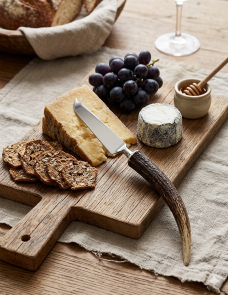
A truly memorable cheese board is defined not by the quantity of its offerings, but by the quality of the experience. The difference between a simple snack and an elegant ritual often comes down to a single, crucial detail: the right tool for the job. Understanding the interplay between a cheese''s structure and a knife''s design transforms serving from a clumsy task into a graceful act.
Beyond the Board: Understanding Cheese Structure
Before we can slice correctly, we must first understand what we are slicing. Cheeses are often categorized by flavour, origin, or milk type, but for the host, the most practical classification is by texture and density. This physical structure dictates how a cheese will behave under the pressure of a blade.
The key determinant of texture is moisture content. Fresh, soft cheeses like Brie, Camembert, and a young Chèvre have high moisture content, resulting in a soft, yielding paste. As a cheese ages, it loses water through evaporation. This process concentrates its fats and proteins, resulting in a firmer, denser, and more crystalline structure. A 60-day cheddar is semi-hard and pliable; a 24-month aged cheddar is hard, brittle, and crystalline.
This aging process creates different challenges for serving:
- Soft Cheeses (e.g., Brie, Triple Crème): The high fat and moisture content causes them to adhere to a blade''s surface. The wrong knife will drag through the paste, smearing it and collapsing the delicate structure.
- Semi-Hard Cheeses (e.g., Gruyère, Havarti, young Gouda): These are generally cooperative, but require a blade long enough to make a clean, single-motion cut without sawing back and forth.
- Hard Cheeses (e.g., Parmigiano-Reggiano, Aged Cheddar, Pecorino Romano): Their low moisture and high density make them resistant to slicing. Applying force with a flimsy blade can cause the cheese to fracture and crumble unpredictably, rather than cleaving cleanly.
- Crumbly Cheeses (e.g., Feta, Blue Cheese): These have a loose curd structure. They are designed to fall apart and require a tool that can guide this separation rather than fight it.
Respecting these physical properties is the first step toward building a better board.
The Geometry of the Cut: Matching Blade to Cheese
The world of cheese knives is not a matter of aesthetics alone; it is a study in applied physics. Each blade shape is engineered to solve a specific problem presented by a cheese''s texture.
The Soft Cheese Specialist
To combat the sticky nature of a soft-ripened Brie or a creamy Cambozola, knives for soft cheese focus on minimizing surface area. You will find two common designs:
- The Perforated Blade: The holes in the blade reduce the amount of metal that comes into contact with the cheese, dramatically decreasing drag and adhesion. The paste has nowhere to stick, allowing the knife to glide through cleanly.
- The Skeleton Blade: This design takes the concept further, with only a thin frame for a blade. It is the ultimate expression of minimal surface area, reserved for the stickiest, gooiest cheeses.
The Hard Cheese Powerhouse
Hard cheeses require force. The knives designed for them are built to channel downward pressure effectively. The classic spade knife (or parmesan knife) has a short, sharp, triangular point. It is not for slicing, but for cracking. You press the point into the wheel and pry off crystalline chunks. For slicing hard blocks like aged cheddar, a small, sturdy cleaver with a flat-profile blade allows you to apply significant pressure from above without the blade flexing or bending.
The Versatile All-Rounder
For semi-hard cheeses, the most useful tool is often the fork-tipped spear. The blade is typically narrow and long enough to handle a decent-sized block of Gruyère or Jarlsberg. Its key feature is the upturned, forked tip, which allows you to slice the cheese and then use the same tool to pick up the slice and place it on a cracker or plate. This simple, elegant design prevents guests from having to pinch the cheese with their fingers.
The Physics of the Perfect Slice: Handle, Heft, and Control
When confronting a dense, high-value block of 3-year aged cheddar, the blade is only half of the story. The handle is the interface between your hand and the cheese; its material, weight, and balance are what determine whether you achieve a clean, confident slice or a crumbled mess. This is where the principles of craft and material science become paramount for the discerning host.
Handle Weight and Balance
The act of slicing a hard cheese requires significant downward force. A lightweight, flimsy handle forces you to generate all of this pressure through muscular effort in your wrist and forearm, leading to fatigue and a lack of control. A substantial handle acts as a partner in this effort. A handle with a mass between 80 and 120 grams provides natural ballast, allowing gravity to do much of the work. The user''s role shifts from applying brute force to simply guiding the blade.
The balance point is equally critical. For hard cheeses, a knife with its centre of mass located towards the bolster (where the blade meets the handle) provides superior control. This handle-ward balance makes the tool feel anchored in the hand, translating small, precise movements from your fingers directly to the blade. This principle of balanced weight and tactile grip is at the core of how we design our tools; a well-made Antler Cheese Knife is crafted not just for aesthetics, but for the precise mechanical function of serving cheese. The dense, solid structure of naturally shed New Zealand red deer antler provides this necessary heft organically.
Grip Friction and Torque
Now, consider the force itself. When you press down, you are also applying subtle rotational force—or torque—to keep the blade straight. On a smooth, low-friction surface like polished steel or lacquered wood, your hand can easily slip, especially if it is slightly damp. This slip causes the blade to twist, which is the primary reason why the last portion of a slice often breaks off.
A material with a high coefficient of friction is the solution. The natural, unique texture of a deer antler handle provides this grip. Its subtle ridges, pores, and contours create thousands of microscopic anchor points against your skin. This high-friction surface ensures that virtually 100% of the force and torque you apply is transferred to the blade. It prevents the subtle slipping that leads to fracturing and gives you the confidence to maintain a consistent angle from the beginning of the slice to the very end.
This tactile feedback from a natural material is something that cannot be replicated in a synthetic polymer. It allows you to feel the resistance of the cheese and modulate your pressure accordingly, making you a more intuitive and effective host.
A Practical Guide to Pairings
Let''s apply this theory to a few common scenarios on the charcuterie board.
The Hard Cheese Challenge: Parmigiano-Reggiano Forget slicing. This cheese''s granular, crystalline structure demands a different approach. Use a short, sharp spade knife. Insert the tip vertically into the top of the cheese and apply firm, direct pressure. Wiggle it slightly to create a fissure, then pry a rustic shard away from the main block. The key is a sturdy handle that won''t slip as you apply this pressure.
The Semi-Hard Slice: A Mature Gouda A fork-tipped spear is perfect here. Position the block with the longest cut-face towards you. Place the blade at the far end and draw it towards you in a single, smooth motion. Do not saw back and forth. The weight of a good knife should do most of the work. Once the slice is complete, use the tines to lift it gracefully.
The Soft Cheese Dilemma: A Ripe Brie Allow the cheese to sit at room temperature for no more than 20-30 minutes. Use a perforated or skeleton blade. Start the cut at the outer rind and slice downwards in one decisive motion. The reduced surface area will prevent the creamy paste from clinging to the blade, ensuring the wedge maintains its shape.
The Crumbly Conundrum: Stilton or Feta For block-style blue cheeses or feta, a simple, thin-bladed knife or even a cheese wire is best. The goal is to cleave the cheese along its natural, crumbly lines. A heavy or wide blade will only compact the curds. Press straight down with minimal fuss.
Serving cheese with intention is an art form grounded in practicality. It demonstrates a respect for the cheesemaker''s craft and a deep consideration for your guests'' experience. By understanding the simple mechanics of density, texture, and leverage, you can transform your cheese board from a mere presentation of food into a moment of shared, effortless elegance. The right tool, born from natural materials and thoughtful design, makes all the difference.
Related reading
Craft & Materials· 6 min read
Patio Hosting Mechanics: Selecting Slip-Resistant Tools for Summer Barbecues
A guide to high-durability, slip-resistant barbecue tools. We analyze why natural antler grips better than polymer in wet conditions for confident patio hosting.
Read article →

Craft & Materials· 6 min read
Replacing Greenwashed Corporate Swag with Genuinely Sustainable Luxury
Tired of disposable corporate swag? Discover how naturally shed deer antler offers a truly sustainable, carbon-neutral luxury gift that lasts a lifetime.
Read article →
Craft & Materials· 6 min read
The Psychology of Hosting: How Weighty Bar Tools Change the Guest Experience
Discover the psychology of hosting. We break down the weight-value heuristic, revealing how the heft of quality bar tools subconsciously signals value to your guests.
Read article →